
Learn how to track your expenses, find hidden spending leaks, review recurring costs, and set realistic limits, with a simple 7-day challenge to get started.
Overspending is rarely the result of one big mistake. More often, it comes from small purchases that seem harmless in the moment: a coffee on the way to work, a takeout order because you didn't want to cook, a sale item you didn't plan to buy, a subscription you forgot you had.
Viewed one at a time, none of these looks serious. Viewed together at the end of the month, they can account for a surprising share of your income.
This guide explains why overspending is so hard to notice, how to track your spending in a way that works, and how to turn that information into better decisions without feeling deprived.
Why Overspending Is So Hard to Spot
Small decisions hide big totals. Spending $10 today and $15 tomorrow feels manageable. But if purchases like these happen several times a week, they can add up to hundreds of dollars a month. The cost is spread across so many moments that no single one feels like the problem.
Automatic payments remove the decision. Subscriptions, memberships, and app renewals continue whether or not you use them. Because no one asks you to approve them each month, they become invisible.
Convenience is expensive. People tend to spend more when they are tired, rushed, stressed, or unprepared. Ordering food instead of cooking, taking a ride-hailing service instead of public transport, and grabbing unplanned items while shopping all become habits.
Memory is unreliable. Most people underestimate their discretionary spending because they remember the big purchases and forget the small ones.
The solution to all four problems is the same: make your spending visible.
You cannot change a spending habit if you don't know how often it happens or what it costs.
Expense Tracking vs. Budgeting: Know the Difference
The two are related but not the same.
- Expense tracking tells you what happened.
- A budget tells you what you plan to do.
Tracking comes first. A budget built without real data is a guess. A budget built on 30 days of actual spending is a plan.
Related Article
How to Create a Monthly Budget That Actually Works: A Simple Step-by-Step Guide
Once you understand where your money is going, the next step is turning that information into a practical monthly budget.
What to Record for Every Expense
For each transaction, capture:
- The date
- What you bought
- The amount
- The category
- Whether it was planned or unplanned
- The payment method (optional, but useful for spotting card or cash patterns)
| Date | Expense | Category | Amount | Planned? |
|---|---|---|---|---|
| Oct 1 | Groceries | Food | $45 | Yes |
| Oct 1 | Coffee | Food | $5 | No |
| Oct 2 | Streaming service | Entertainment | $12 | Yes |
| Oct 2 | Takeout | Food | $18 | No |
The "Planned?" column is the most underrated. It separates spending that supports your priorities from spending that happened to you.
Step 1: Track Everything for 30 Days
Record every expense for one full month, including the small ones: transport, groceries, meals out, subscriptions, entertainment, shopping, bills, and bank fees.
During this period, try not to change your behavior just because you're being observed. The goal of month one is accurate data, not perfection. Think of it as a financial observation period.
At the end, you should be able to answer questions like:
- How much did I spend on food? On transport? On entertainment?
- How much of my spending was unplanned?
- Which expenses kept recurring?
- Which categories grew the most?
These answers are hard to get from memory alone.
Choose a tracking method you will actually use.
| Method | Best for | Watch out for |
|---|---|---|
| Notebook or notes app | Simplicity, cash-heavy spending | Easy to skip, hard to total |
| Budgeting app | Automatic bank syncing | Can feel hands-off, so you may not engage with the data |
| Spreadsheet | Control, customization, seeing totals | Needs a good structure to start with |
The best tool is the one you will still be using in month three.
Step 2: Sort Spending into Needs, Wants, and Unexpected Costs
Once your transactions are recorded, group them into three broad buckets.
Needs are costs essential to daily life: housing, basic food, utilities, transport, insurance, and minimum debt payments.
Wants are discretionary spending that improves your lifestyle but isn't essential: dining out, entertainment, shopping, premium subscriptions, and recreation.
Unexpected expenses fall outside your normal pattern: emergency repairs, medical bills, unplanned travel.
These categories are personal, not absolute. A car may be a need for one person and a convenience for another. The point is not to judge your purchases but to understand the role each one plays in your life.
If unexpected expenses show up every month, that is useful information too. It suggests they aren't really unexpected, and that you need a small buffer or sinking fund for them.
Step 3: Find Your Biggest Spending Leaks
Total each category. Here is an example monthly summary:
| Category | Monthly spending |
|---|---|
| Housing | $1,000 |
| Food | $450 |
| Transportation | $250 |
| Entertainment | $180 |
| Shopping | $220 |
| Subscriptions | $75 |
The largest category is not automatically the one to cut. Housing is the biggest line here, but it's also the hardest to change and is a genuine need.
Ask a better question instead:
Which category gives me the least value for the money I'm spending?
Food at $450 may be perfectly reasonable if it feeds a whole household. But if $120 of it is impulse takeout and $75 goes to subscriptions you rarely open, those are your leaks.
A useful trick: annualize it. Multiply any recurring or habitual cost by 12. A $15 weekly snack habit becomes about $780 a year. A $10 forgotten subscription becomes $120. Seeing the yearly figure changes how the monthly one feels.
Step 4: Audit Your Recurring Expenses
Recurring charges deserve their own review because they are the easiest to ignore. Go through your bank and card statements and look for:
- Streaming services
- Software and app subscriptions
- Cloud storage
- Gym or club memberships
- Premium accounts and free trials that converted to paid
- Bank and card fees
For each one, ask three questions:
- Have I used this in the last 30 days?
- Would I sign up for it again today at this price?
- Is there a cheaper plan, or a shared one, that does the same thing?
Ten $10 subscriptions equal $100 a month, or $1,200 a year. You don't need to cancel everything. You need to make sure each one is a deliberate choice rather than a leftover.
Step 5: Identify Your Spending Triggers
Tracking reveals more than numbers. It reveals the situations that drive your spending. Look for patterns:
- Do you spend more when you're stressed or tired?
- Do you order food after long workdays?
- Do sales pull you into purchases you hadn't planned?
- Does spending spike right after payday?
- Do social events regularly push you past your plan?
Once you know the trigger, you can design around it instead of relying on willpower.
| Trigger | Practical fix |
|---|---|
| Tired after work, order takeout | Prepare simple meals or batch-cook on weekends |
| Impulse buying during sales | Add items to a wishlist and wait 48 hours before buying |
| Payday splurges | Move savings and bill money out of your spending account first |
| Social spending | Set a monthly "fun" amount in advance |
| Boredom scrolling and shopping | Delete shopping apps or remove saved card details |
Changing the system around the behavior works better than telling yourself to "spend less."
Step 6: Set Realistic Spending Limits
With real data in hand, set limits for the categories you want to control.
If you spend about $450 a month on food and decide $375 is a better target, you now have a measurable goal. That is a 17% reduction, which is achievable without extreme sacrifice.
A few principles help:
- Start with one or two categories, not all of them.
- Prefer small, sustainable cuts over aggressive ones. A 15% reduction you maintain for a year beats a 40% cut you abandon in two weeks.
- Base limits on your actual income, fixed obligations, and goals, not on someone else's template.
- Leave room for enjoyment. A budget with zero flexibility tends to fail.
If you want a starting framework, the popular 50/30/20 rule suggests roughly 50% of income for needs, 30% for wants, and 20% for savings and debt repayment. Treat it as a reference point, not a rule. Your own numbers matter more.
Step 7: Hold a 15 Minute Weekly Money Review
Don't wait until month-end to learn you've overspent. Set aside about 15 minutes each week and ask:
- How much did I spend this week?
- Which category used the most money?
- Were there purchases I didn't need?
- Am I still within my limits?
- What bills or expenses are coming next week?
- What, if anything, should I adjust?
This creates a feedback loop: spend, review, notice, adjust. Small problems get caught while they are still small, and the habit gradually becomes automatic.
Common Expense Tracking Mistakes to Avoid
- Only tracking large purchases. Small ones are usually where the leaks are.
- Quitting after one missed day. Missing a day isn't failure. Resume the next day and estimate what you missed.
- Tracking without reviewing. Data you never look at changes nothing.
- Judging yourself. The first month is for observing, not for guilt.
- Using an overly complicated system. If it takes too long, you won't keep doing it.
- Ignoring cash spending. Cash leaves no trail, so note it down immediately.
Do You Need a Special Tool?
No. A notebook, an app, or a spreadsheet will all work. Consistency matters far more than sophistication.
At a minimum, your tracker should let you record the date, description, category, and amount, and show you totals without complicated formulas. More advanced systems can connect expenses to budgets, savings goals, debt, and net worth.
From Tracking to a Complete Financial System
Once expense tracking becomes routine, you can start asking a bigger question: not just where did my money go? but where should it go next?
At that point, your expense data becomes the foundation for a broader system: a realistic budget, savings targets, debt repayment plans, and a clear view of your net worth over time. Instead of seeing isolated transactions, you start to see how the pieces of your financial life connect.
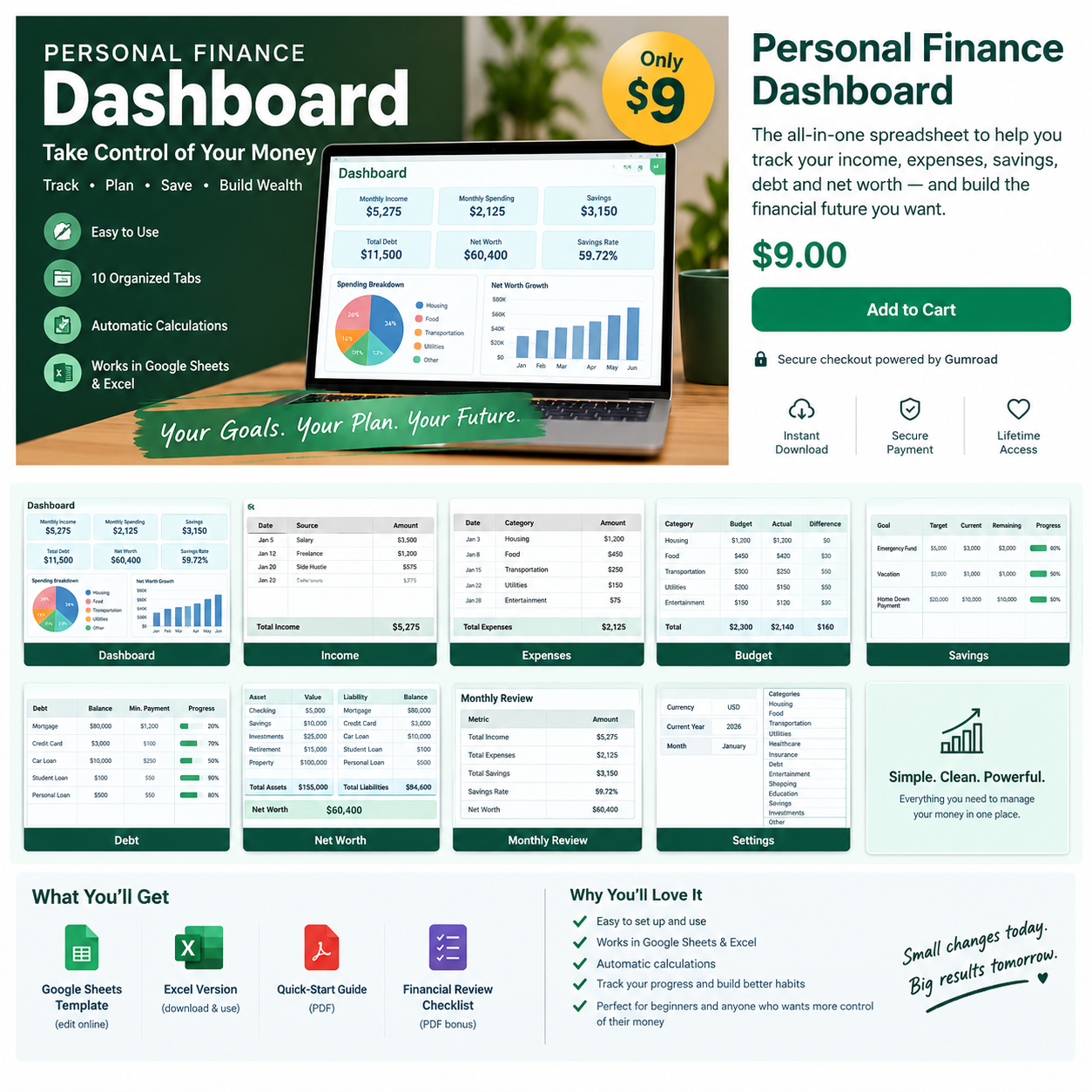
If you prefer working in spreadsheets, a ready-made structure can save you the effort of building everything from scratch. That is the purpose of the Personal Finance Dashboard: a spreadsheet-based tool that brings income, expenses, budgets, savings, debt, and net worth into one place.
A dashboard won't change your financial habits by itself. What it can do is make your information easier to organize, review, and act on. You can start with simple expense tracking and expand into other areas when you're ready.
Related Article
Personal Finance Dashboard: A Simple Way to Track Your Budget, Savings, Debt and Net Worth
Learn how a structured dashboard can bring your income, expenses, budget, savings, debt, and net worth information together in one place.
A 7-Day Expense-Tracking Challenge
If a full month feels like too much, begin with one week.
| Day | Action |
|---|---|
| Day 1 | Record every expense, no matter how small |
| Day 2 | Assign a category to each expense |
| Day 3 | Mark which purchases were unplanned |
| Day 4 | Review your recurring charges and subscriptions |
| Day 5 | Identify your largest discretionary category |
| Day 6 | Set one realistic spending limit |
| Day 7 | Review the week and choose one change you can sustain |
After seven days, keep going for another week. Then another. The aim is a habit that eventually becomes part of your normal monthly routine.
Frequently Asked Questions
The Goal Is Not to Stop Spending
Tracking should never become punishment. Money exists to cover necessities, support your goals, and leave room for things you value.
The goal is intentional spending. When you know where your money goes, you can decide what deserves more of it and what deserves less. You might cut back on shopping to afford travel. Someone else might drop entertainment subscriptions to enjoy dining out. There is no universal pattern. What matters is that your spending reflects your income, obligations, and priorities.
Start With Visibility
Controlling overspending doesn't begin with earning more or making drastic changes. It begins with seeing clearly what is already happening.
Track your expenses. Categorize them. Look for patterns. Review recurring costs. Find the spending that doesn't give you enough value. Then set realistic limits and check in regularly.
You don't need to change everything at once. One habit, one category, and one weekly review is enough to start. And once you have reliable information about where your money is going, you are far better placed to decide where you want it to go next.
This article is for educational purposes only and is not personalized financial advice. Consider consulting a qualified financial professional for decisions specific to your situation.