

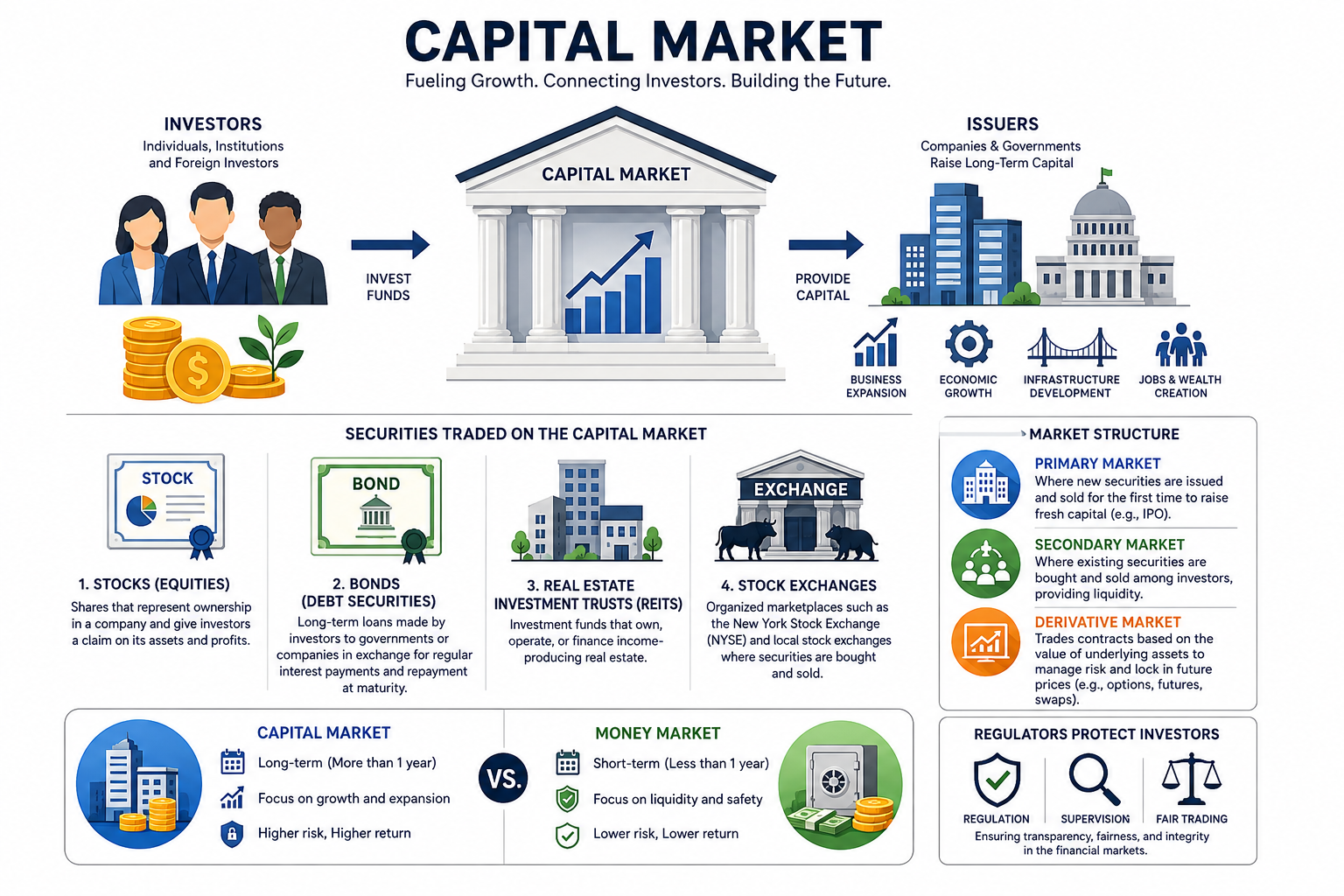
Financial markets include several different markets, each serving a specific purpose. These include the capital market, money market, foreign exchange market, and derivatives market.
Capital Market
A capital market is a financial marketplace where buyers and sellers trade long-term financial assets such as stocks and bonds.
It provides opportunities for those who have and are willing to invest on long terms (investors) to channel their funds through intermediation process to those who are willing to obtain such funds (companies and governments) on long term as well.
This system helps businesses expand, supports economic growth, and finances public infrastructure and development projects.
The following securities are traded on the capital market:
-
Stocks (Equities): Shares that represent ownership in a company and give investors a claim on its assets and profits.
-
Bonds (Debt Securities): Long-term loans made by investors to governments or companies in exchange for regular interest payments and repayment at maturity.
-
Real Estate Investment Trusts (REITs): Investment funds that own, operate, or finance income-producing real estate.
-
Stock Exchanges: Organized marketplaces such as the New York Stock Exchange (NYSE) and local stock exchanges where securities are bought and sold.
Money market
This is a market where short-term funds and short-term financial instruements (usually of one-year maturity) are issued and traded. In order words, it provides avenue for the supplier of and demand for funds on short term basis through issuance of and trading in such securities as;
-
Treasury bills
-
Treasury certificate
-
commercial papers
-
certificate of deposit
-
bankers acceptance.
-
Repurchase agreement
For any security or instruement to be classified as money market instruement, it must give little or no risk to the holder and must provide liquidity.
The capital market can be subdivided into two, namely;
-
The primary market
-
The secondary market
However , the third division called the “derivative market” is relatively underdeveloped
1. Primary Market
The primary market is where companies or governments issue and sell new stocks or bonds to investors for the first time. This is how organizations raise fresh capital, such as through an Initial Public Offering (IPO).
The apex regulatory body for primary market is the securities and exchange commission (SEC) which regulate the issuance of shares and stocks by pulic and all private companies with foreign interest.
Functions of the primary market
-
Determination of the amount of the price and time at which securities of a company are to be sold to the public either through offer for sale or subscription.
-
Registration of all securities proposed tp be offered for sale to or subscription by the public or to be offered privately.
-
To maintain effective supervison over the securities market to ensure orderly , fair and equitable dealings in securities.
-
Registration of stock exchanges, their branches, registrars, securities dealers, investment advisers, agents and control and supervision of their ativities in order to maintain high standards of conduct and professionalism in the scurities market.
-
To protect the integrity of the securities market against any abuse arising from the practice of insiders trading.
-
To review, approve and regulate mergers for the orderly and smooth growth of the capital market.
2. Secondary Market
The secondary market is where investors buy and sell existing securities among themselves rather than purchasing them directly from the issuing company. It can therefore be called “investor market.”
The activities of the secondary market are usually carried out on the floor of the stock exchange where investors and sellers of securities meet on daily basis during trading hours to consummate deals through their stockbrokers who are the dealing members of the exchange. This market provides liquidity, allowing investors to trade their investments whenever they choose.
Note: Instruements issued at both money market and capital markets can be traded at their respective secondary markets. However, while capital market instruement are usually traded on the floor of the stock exchange, money market instruements can be traded among market operators without necessarily passing through the central bank or any regulatoray institutions.
Functions of the secondary market
-
It provides a market for securities that have been formally issued in the primary market for individuals, and corporate bodies to raise funds.
-
It regulates and determines current market price of quoted company shares.
-
It encourages wider ownership of company’s share holdings.
-
It provides an avenue for medium and even low income earners to participate and become shareholders of internstionsl companies.
THE DERIVATIVE MARKET
The derivative market is relatively underdeveloped; it trades not on issued security but on the right to title on underlying security or on the basis of the future title to the security. This financial future market operstes to provide not only an hedge against exchange rate fluctuation but also against interest rate fluctuation , and this is of particular interest to portfolio, pension and other funds managers.
Examplies of derivative market on the stock exchange is:
-
Right offer
-
Options
-
Future
-
Swaps etc.
Capital Market vs. Money Market
Although both are part of the financial market, the capital market and money market serve different purposes.
Capital Market
The capital market deals with long-term investments that typically have maturities of more than one year. It helps companies and governments raise funds for long-term growth, expansion, and infrastructure projects.
Common capital market instruments include:
-
Stocks (Equities): Shares that show ownership in a company.
-
Bonds (Debt Securities): Long-term loans given to governments or companies.
-
Real Estate Investment Trusts (REITs): Funds that invest in real estate assets.
-
Stock Exchanges: Marketplaces like the New York Stock Exchange or local exchanges where shares are traded.
Money Market
The money market deals with short-term, highly liquid financial instruments that mature in less than one year. It provides a safe environment for managing short-term cash needs while maintaining high liquidity.
Common money market instruments include:
-
Treasury Bills (T-Bills): Short-term government-backed securities.
-
Commercial Paper: Short-term unsecured loans issued by large companies.
-
Certificates of Deposit (CDs): Bank deposits with a fixed maturity date.
-
Repurchase Agreements (Repos): Short-term agreements to sell and repurchase securities.
-
Examples of major stock exchanges around the world.
-
The role of market regulators in protecting investors and ensuring fair trading.