

Learn how to create a monthly budget that actually works. Track your income, control spending, build savings, reduce debt, and stay on top of your finances with a simple budgeting system.
Creating a monthly budget is one of the simplest ways to gain a clearer understanding of your finances. Yet for many people, creating the budget is easier than sticking to it.
A spreadsheet may look perfect at the beginning of the month, with income, expenses, savings and financial goals carefully listed. A few weeks later, however, unexpected expenses, impulse purchases and rising bills can quickly throw the plan off course.
The problem is not necessarily budgeting itself. In many cases, the problem is creating a budget that is too complicated, too restrictive or disconnected from how money is actually spent.
A monthly budget should be practical. It should help you understand where your money is going, prepare for upcoming expenses and make better financial decisions without becoming another difficult task to maintain.
What Is a Monthly Budget?
A monthly budget is a financial plan that shows how much money you expect to receive and how you intend to use it during a particular month.
It normally includes income, essential expenses, discretionary spending, savings and debt payments.
For example, someone earning $3,000 in a month may allocate part of that income to housing, food, transportation, utilities, debt payments and savings. The remaining amount can then be assigned to other spending categories or kept as a financial buffer.
The purpose of a budget is not simply to stop spending money. It is to give your money a purpose before you spend it.
Step One: Calculate Your Monthly Income
The first step is to determine how much money you expect to receive during the month.
This could include salary, freelance income, business income, rental income, investment income and other reliable sources of money.
If your income is predictable, calculating this amount should be relatively straightforward. If your income changes from month to month, consider using a conservative estimate rather than assuming you will earn your highest possible amount.
For example, if you expect to receive $3,000 during the month, that figure becomes the starting point for your budget.
Your total planned spending, savings and debt payments should then be considered against that amount.
Step Two: List Your Fixed Expenses
Next, write down expenses that generally remain the same each month.
These can include:
-
Rent or mortgage payments
-
Insurance
-
Loan payments
-
Internet services
-
Telephone bills
-
Subscription services
-
Other regular financial obligations
For example, if your monthly rent is $900, insurance costs $150 and loan payments total $200, those expenses should be included before deciding how much money is available for other categories.
Knowing your fixed expenses gives you a clearer picture of how much of your income is already committed.
Step Three: Estimate Your Variable Expenses
Variable expenses can change from month to month. These include groceries, transportation, entertainment, shopping, restaurants and personal expenses.
This is where reviewing your previous spending becomes important.
Instead of simply guessing how much you spend on food or transportation, examine your bank statements, payment records or receipts from previous months.
If you discover that you normally spend $400 on groceries, setting a budget of $100 may be unrealistic.
A more effective approach is to start with your actual spending and gradually identify areas where you can make reasonable reductions.
Step Four: Separate Needs From Wants
Understanding the difference between needs and wants can make budgeting easier.
Needs generally include expenses required to maintain your basic lifestyle and financial obligations, such as housing, basic food, utilities, transportation and insurance.
Wants may include restaurant meals, entertainment, non-essential shopping, premium subscriptions and other discretionary purchases.
This does not mean that all discretionary spending should be eliminated.
A budget that leaves no room for enjoyment can become difficult to maintain. Instead, the goal should be to make sure that spending on wants does not prevent you from covering important expenses, saving money or reducing debt.
Step Five: Make Savings Part of the Budget
One common budgeting mistake is treating savings as whatever remains at the end of the month.
If possible, make savings a planned part of your budget.
You may be saving for an emergency fund, education, a home, retirement, a business, travel or another major financial goal.
For example, if you decide to save $300 every month, include that amount in your budget from the beginning.
This changes saving from something you hope to do into a specific financial objective that can be tracked.
Step Six: Include Debt Payments
If you have debt, your monthly budget should account for required payments.
You can also decide whether you want to make additional payments toward your balances.
For example, you might have a required monthly debt payment of $300 and decide to allocate another $100 toward reducing the outstanding balance.
Tracking debt separately can make it easier to see whether your financial obligations are increasing or decreasing over time.
Step Seven: Compare Your Budget With Actual Spending
Creating a budget at the beginning of the month is only the first part of the process.
You also need to track what actually happens.
Suppose you allocate $400 for food but spend $500. Your budget should make that difference visible.
A simple comparison can look like this:
| Category | Planned Amount | Actual Amount | Difference |
|---|---|---|---|
| Food | $400 | $500 | -$100 |
| Transportation | $200 | $180 | $20 |
| Entertainment | $150 | $100 | $50 |
| Shopping | $100 | $130 | -$30 |
This information is useful because it shows exactly where your spending is different from your original plan.
If you consistently spend more than expected in one category, you can investigate why and adjust your future budget accordingly.
Step Eight: Prepare for Unexpected Expenses
Unexpected expenses are one of the biggest reasons budgets fail.
A car repair, medical bill, home repair, annual subscription or family expense can quickly disrupt a carefully planned month.
While you cannot predict every expense, you can create a financial buffer.
Leaving some money unallocated can provide room for unexpected costs. You can also create separate savings for expenses that may not happen every month but are likely to occur eventually.
For example, if you know that you normally spend money on vehicle maintenance several times a year, setting aside a small amount each month can make the eventual expense easier to manage.
Step Nine: Review Your Budget Every Month
A budget should not be created once and forgotten.
At the end of each month, review your results.
Ask yourself:
-
Did I stay within my planned spending?
-
Which categories went over budget?
-
Did I reach my savings target?
-
Did my debt decrease?
-
Were there unexpected expenses?
-
What should I change next month?
The purpose of the review is not to punish yourself for overspending.
Instead, it is an opportunity to learn from the previous month and create a more realistic plan for the next one.
Make Your Budget Easier to Manage With a Personal Finance Dashboard
A monthly budget can tell you how much you planned to spend and whether you stayed within your limits. However, your overall financial picture involves more than monthly expenses.
You may also want to track savings, debt and net worth.
This is where a personal finance dashboard can become useful.
Instead of keeping income in one spreadsheet, expenses in another file and savings goals in a notebook, a personal finance dashboard can bring important financial information together in one place.
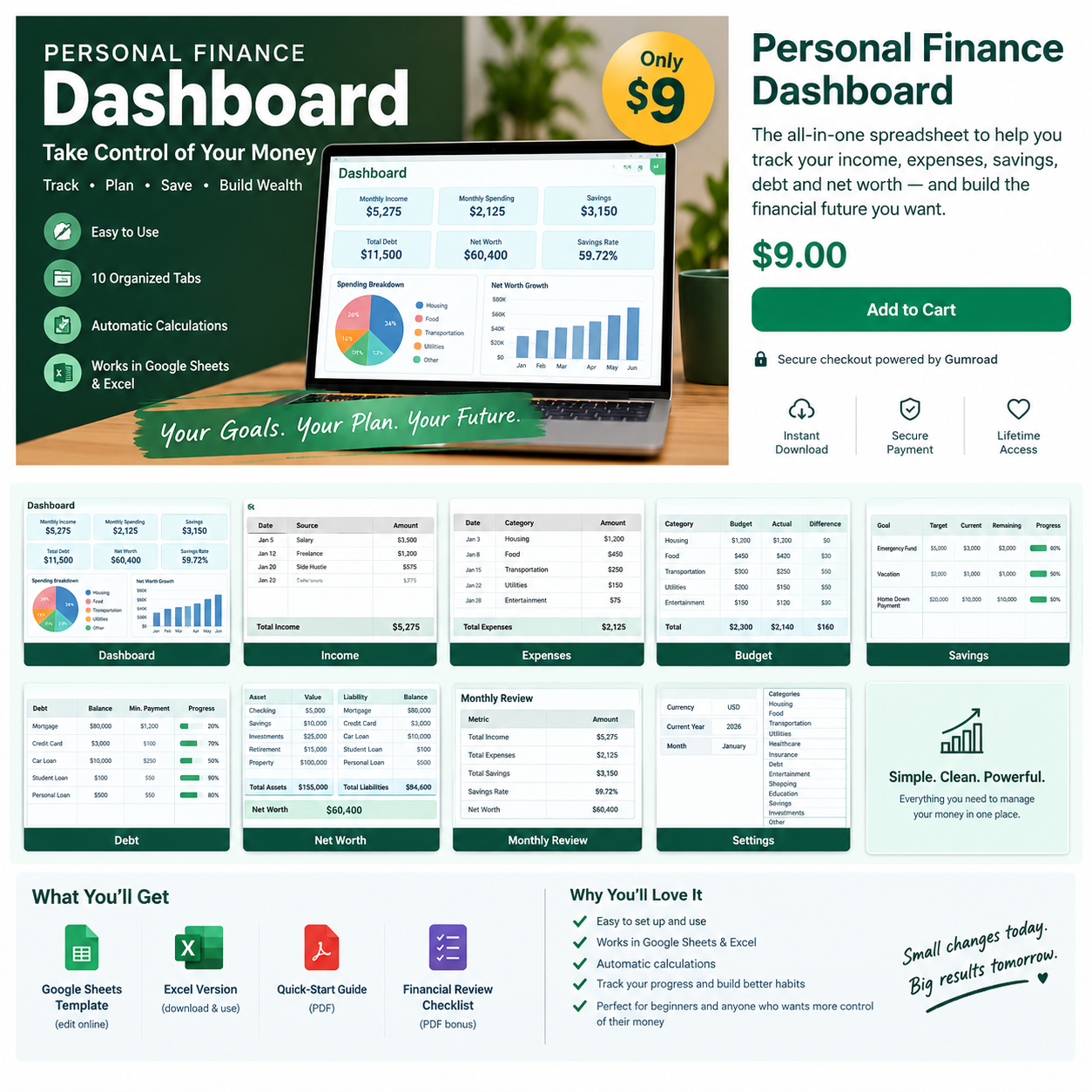
A well-organized dashboard can help you monitor income, expenses, budget performance, savings goals, debt balances and net worth.
For example, the Personal Finance Dashboard I created is designed to give users a central place to organize these areas of their finances.
It includes sections for income, expenses, budgeting, savings, debt and net worth, allowing users to enter their financial information and review their progress over time.
The dashboard is particularly useful after creating a monthly budget because it turns the budgeting process into something that can be monitored throughout the month.
Instead of simply deciding that you will spend less, you can record your spending, compare it with your budget and identify areas that need attention.
👇 👇 👇
A successful monthly budget does not have to be perfect. Some months will be more expensive than others. Unexpected expenses will happen. Income may change. Financial priorities may also evolve.
What matters is having a system that allows you to see what is happening with your money and make informed adjustments.
Start by calculating your income, listing your regular expenses, estimating variable spending, setting savings goals and including debt payments. Then track your actual spending and review the results at the end of each month.
Over time, this process can help you develop a clearer understanding of your financial habits.
The most useful budget is not necessarily the most complicated one. It is the one you can understand, maintain and use consistently.
Once your monthly budget is in place, bringing your income, expenses, savings, debt and net worth together in a Personal Finance Dashboard can make the process even easier to manage.
Start with a budget. Track what happens. Review your progress. Then use what you learn to make the next month better.