

Learn 10 proven personal finance habits, from budgeting and emergency savings to debt tracking and net worth, plus a simple system to stay consistent.
Effective money management is less about how much you earn and more about the habits you build around it. Two people with the same income can end up in very different positions, depending on whether they track their spending, plan for irregular costs, save with a purpose and review their progress regularly.
This guide covers 10 personal finance habits that help you understand where your money comes from, where it goes and whether your decisions are moving you toward your goals. Each one includes practical steps you can apply this month.
In this guide:
- Track your income
- Know where your money goes
- Create a realistic monthly budget
- Review your spending regularly
- Build an emergency fund
- Set specific savings goals
- Keep your debt under control
- Monitor your net worth
- Plan for irregular expenses
- Conduct a monthly financial review
1. Track Your Income
You cannot manage money well until you know exactly how much you have to work with. Many people rely on estimates, and income is easy to misjudge, especially when it comes from several places, such as:
- Salary or wages
- Freelance or contract work
- Business income
- Investment returns
- Rental income
- Occasional or one-off payments
How to do it: Record each payment when you receive it, including the source, amount and date. If your income varies, look at the last six to twelve months and use a conservative average as your budgeting baseline. In months when you earn more, treat the extra as a bonus for savings or debt repayment rather than raising your regular spending.
Knowing your true income tells you how much can realistically go toward expenses, savings, debt repayment and long-term goals.
2. Know Where Your Money Goes
Income is only half the picture. Small, repeated purchases such as food delivery, subscriptions, transport and impulse buying can quietly add up to a large share of your monthly spending.
How to do it: Sort every expense into categories rather than looking only at the total. Common categories include:
- Housing
- Food and groceries
- Transportation
- Utilities
- Healthcare and insurance
- Debt payments
- Entertainment and shopping
- Education
- Savings and investments
Categories make patterns visible. You may discover that dining out costs more than groceries, or that several forgotten subscriptions are draining your account.
The goal is not to eliminate every non-essential expense. It is to check whether your spending reflects your priorities.
3. Create a Realistic Monthly Budget
A budget gives every unit of income a purpose before it is spent. Many budgets fail because they describe an ideal life instead of a real one. Build yours from your actual spending history.
How to do it:
- Start with your expected monthly income.
- List fixed expenses, which stay stable (rent, insurance, loan payments).
- Estimate variable expenses, which change month to month (food, transport, entertainment).
- Assign amounts to savings and debt repayment.
- Allocate what remains to discretionary spending.
If you want a starting framework, the 50/30/20 guideline suggests roughly 50% of after-tax income for needs, 30% for wants and 20% for savings and debt repayment. Treat it as a reference point, not a rule. Adjust the percentages to your cost of living and goals.
A good budget is not one where every category matches exactly each month. It is one that helps you make deliberate decisions.
Related Article
```How to Create a Monthly Budget That Actually Works: A Simple Step-by-Step Guide
Learn how to build a practical monthly budget using your actual income, expenses, savings goals and spending patterns.
```4. Review Your Spending Regularly
A budget only works if you compare it with reality. Regular reviews let you catch overspending while there is still time to adjust.
Compare budgeted spending with actual spending. Instead of asking "How much have I spent?", ask "How does my spending compare with my plan?"
For example, if you have used your whole entertainment budget by mid-month, you can reduce spending in that category or shift money from another one.
How to do it: Set aside five to ten minutes each week for a quick check, and schedule a more detailed review at month-end. Consistency matters more than length.
5. Build an Emergency Fund
Medical bills, urgent repairs, job interruptions and family emergencies can derail even a well-planned budget. An emergency fund is a cash reserve for these necessary but unpredictable costs, and it helps you avoid borrowing or selling investments at a bad time.
How much to save: A commonly cited benchmark is three to six months of essential living expenses. The right amount depends on your income stability, dependents, health needs and job security. Freelancers and single-income households often aim for the higher end.
How to start: If that target feels far away, begin with one month of expenses, or even a small fixed amount, and contribute consistently. Automating a transfer on payday helps. Treat emergency savings as a fixed part of your budget, not something you save only when money is left over.
6. Set Specific Savings Goals
"Save more" is an intention, not a goal. Savings grow faster when each one has a purpose, a target amount and a deadline.
A simple formula:
Monthly savings needed = Target amount ÷ Number of months
For example, saving for a $6,000 goal over 24 months requires $250 per month. Turning a vague wish into a monthly number makes it easier to fit into your budget and to see whether you are on track.
Common goals include an emergency fund, education, a major purchase, travel, retirement or investing. Track your current savings against each target so progress stays visible and motivating.
7. Keep Your Debt Under Control
Debt is not automatically a sign of poor money management. Mortgages, student loans and business financing can be sensible tools. What matters is understanding how your debt affects your overall financial position.
How to do it: Keep a record of each debt, including the outstanding balance, interest rate, minimum payment and due date. Seeing the total gives you a much clearer view than tracking each debt separately.
Two well-known repayment strategies are:
- Debt avalanche: Pay extra toward the debt with the highest interest rate first. This usually costs the least in total interest.
- Debt snowball: Pay off the smallest balance first. This can build motivation through early wins.
Either approach works if you stay consistent. Also consider how any new debt will affect your monthly budget before taking it on. As balances fall, update your records so you can watch the progress.
8. Monitor Your Net Worth
Income and spending describe your monthly cash flow, but not your overall financial position. Net worth fills that gap.
Net Worth = Assets − Liabilities
- Assets include cash, savings, investments, property and other valuable holdings.
- Liabilities include credit card balances, personal loans, mortgages and other obligations.
Net worth naturally fluctuates as investment values and balances change, so avoid reacting to every short-term movement. Instead, calculate it at regular intervals, such as monthly or quarterly, and look at the trend. A rising trend over time is a strong sign your finances are moving in the right direction.
9. Plan for Irregular Expenses
Not all expenses arrive monthly, but many are predictable: annual insurance premiums, school fees, holidays, vehicle maintenance, home repairs and yearly subscriptions. When they hit unexpectedly, they often push people toward credit or force them to raid savings.
How to do it: List these expenses in advance, estimate the cost, and divide it by the months remaining. For example, an annual expense of $1,200 requires about $100 per month set aside. Keep the money in a separate account or labeled category, sometimes called a sinking fund, so it is ready when the bill arrives.
This turns a stressful surprise into a planned, manageable cost.
10. Conduct a Monthly Financial Review
The habit that ties everything together is a regular financial review. Once a month, look at your income, spending, budget performance, savings, debt and net worth in one sitting.
Questions to ask:
- Did I spend more or less than planned?
- Which categories increased, and why?
- Did I reach my savings target?
- Did my debt balance go down?
- How did my net worth change?
- What unexpected expenses came up?
- What should I adjust next month?
The purpose is not to criticize yourself. It is to spot patterns and make better decisions next month. Over time, your reviews become a record of real financial progress.
Turning Financial Habits Into a Practical System
Knowing what to do is one thing. Doing it consistently is harder when your information is scattered across bank statements, notes, apps and separate spreadsheets.
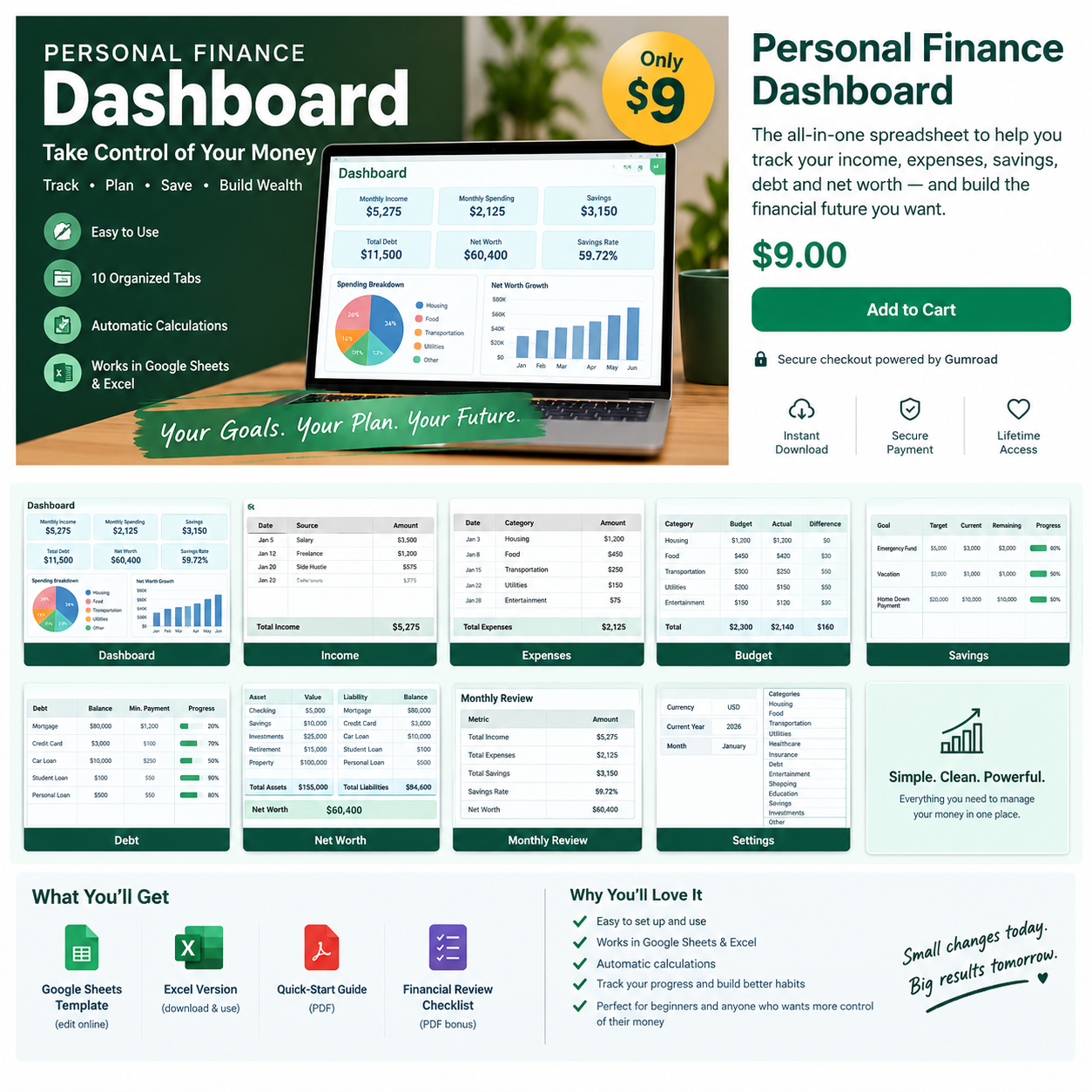
A centralized tracking system solves this. The Personal Finance Dashboard brings your key numbers together in one spreadsheet so you can:
- Record income and expenses
- Set a monthly budget
- Compare planned spending with actual spending
- Monitor savings goals
- Track debt balances and repayment progress
- Calculate changes in net worth
Because everything is already organized, your monthly review takes minutes instead of hours. The real value is not another spreadsheet but a repeatable routine: record, review, adjust, repeat.
Frequently Asked Questions
What is the most important personal finance habit?
How often should I review my finances?
How much should I keep in an emergency fund?
Should I pay off debt or save first?
What is a good way to track net worth?
Make Money Management a Routine
Better finances rarely come from one dramatic change. They come from small decisions repeated consistently: tracking income, understanding spending, budgeting with intention, saving for specific goals, managing debt and reviewing your progress.
You do not need a perfect system. You need one you can maintain. Start with one or two habits from this list, build from there, and let regular reviews show you what is working.
Put These Habits Into Practice
Ready to organize your finances in one place?
Get the Personal Finance Dashboard and start tracking your income, budget, savings, debt and net worth today.
Get the Personal Finance Dashboard → ```This article is for educational purposes only and is not personalized financial advice. Consider consulting a qualified financial professional for decisions specific to your situation.