
Should you buy a dividend ETF or pick individual dividend stocks? A balanced comparison of diversification, effort, cost, and risk for beginners.
New income investors often ask whether they should buy a dividend ETF or pick individual dividend stocks. Neither is automatically better. The right choice depends on your time, goals, and comfort with risk. Here's a fair comparison.
What Is the Difference Between a Dividend ETF and a Dividend Stock?
1. Individual Dividend Stocks
A dividend stock is a share of an individual company that distributes cash to shareholders. When you buy one, your investment performance and dividend income depend partly on that company's financial health, business performance and dividend policy.
2. Dividend ETFs
A dividend exchange-traded fund (ETF) holds a collection of dividend-paying stocks and trades on an exchange like an individual share. The fund collects dividends from its underlying investments and typically distributes income to its investors according to its policies.
Dividend ETFs vs Individual Stocks: A Side-by-Side Comparison
The table below compares the main features to consider before choosing an approach.
| Feature | Dividend ETF | Individual Dividend Stocks |
|---|---|---|
| Diversification | Built in when the fund holds multiple companies. | You build and maintain diversification yourself. |
| Time and effort | Generally less company-by-company research. | Requires researching and monitoring each company. |
| Costs | Usually charges an annual expense ratio, in addition to any applicable trading costs. | May avoid fund expense ratios, but trading costs and research time can still matter. |
| Company-specific risk | A dividend cut by one holding may have less impact, depending on the fund's concentration. | A dividend cut by a major holding can have a more direct effect on your income. |
| Control | The fund's strategy determines which investments it holds. | You choose which companies to own and how much to invest in each. |
| Income predictability | Depends on the fund's holdings, distribution policy and market conditions. | Depends on each company's dividend decisions and financial performance. |
Important: Diversification can reduce the impact of problems at an individual company, but it cannot eliminate market risk or guarantee dividend income. Some ETFs are concentrated in particular sectors or strategies.
Why Many Beginners Start With Dividend ETFs
Dividend ETFs can be a convenient starting point for investors who want exposure to multiple companies without having to research every business individually.
When a fund owns dozens or hundreds of companies, a dividend cut at one company may have a smaller effect on the overall portfolio than it would on a portfolio heavily dependent on that single stock.
The trade-off is that you accept the fund's investment strategy, holdings and distribution policy. You also pay the fund's expense ratio, which reduces returns over time.
Remember that not every dividend ETF is broadly diversified. Check its holdings, sector allocations and selection rules before investing.
Why Some Investors Prefer Individual Dividend Stocks
Individual stocks give investors more control over their portfolios. You can select companies whose businesses you understand, choose which sectors to emphasise and avoid businesses that do not fit your investment preferences.
However, that flexibility comes with additional responsibility. You need to research each company, monitor its financial performance and assess whether its dividend remains sustainable.
Holding only a few stocks can also expose you to greater company-specific risk. Chasing high dividend yields without examining the underlying business can lead to disappointing results.
A Middle-Ground Strategy: Combine ETFs and Individual Stocks
Some investors choose to hold a core portfolio of diversified funds and add a smaller number of individual dividend stocks they have researched carefully.
This approach can combine broad exposure with greater control over selected investments. The appropriate balance depends on your goals, available time, risk tolerance and existing portfolio.
It is not automatically safer or more profitable than choosing one approach. The underlying holdings, fees and overall allocation still matter.
Four Questions to Ask Before You Invest
- How much time can I spend researching?
If you have limited time, an ETF may simplify portfolio management. Individual stocks require more ongoing attention. - How would I react if a company cut its dividend?
Consider whether you could handle a decline in income without making rushed investment decisions. - Do I need income soon or am I investing for years?
Your time horizon and income needs can influence how you evaluate dividend investments. - Do I understand the fund or company?
For an ETF, review its expense ratio, holdings, sector exposure and selection methodology. For an individual stock, examine its financial statements, cash flow, debt and dividend policy.
Related Article
How Dividend Investing Works: Understanding Dividend Dates and Payments
Learn about declaration dates, ex-dividend dates, record dates and payment dates so you can better understand how dividend payments work.
Track Your Dividend Portfolio in One Place
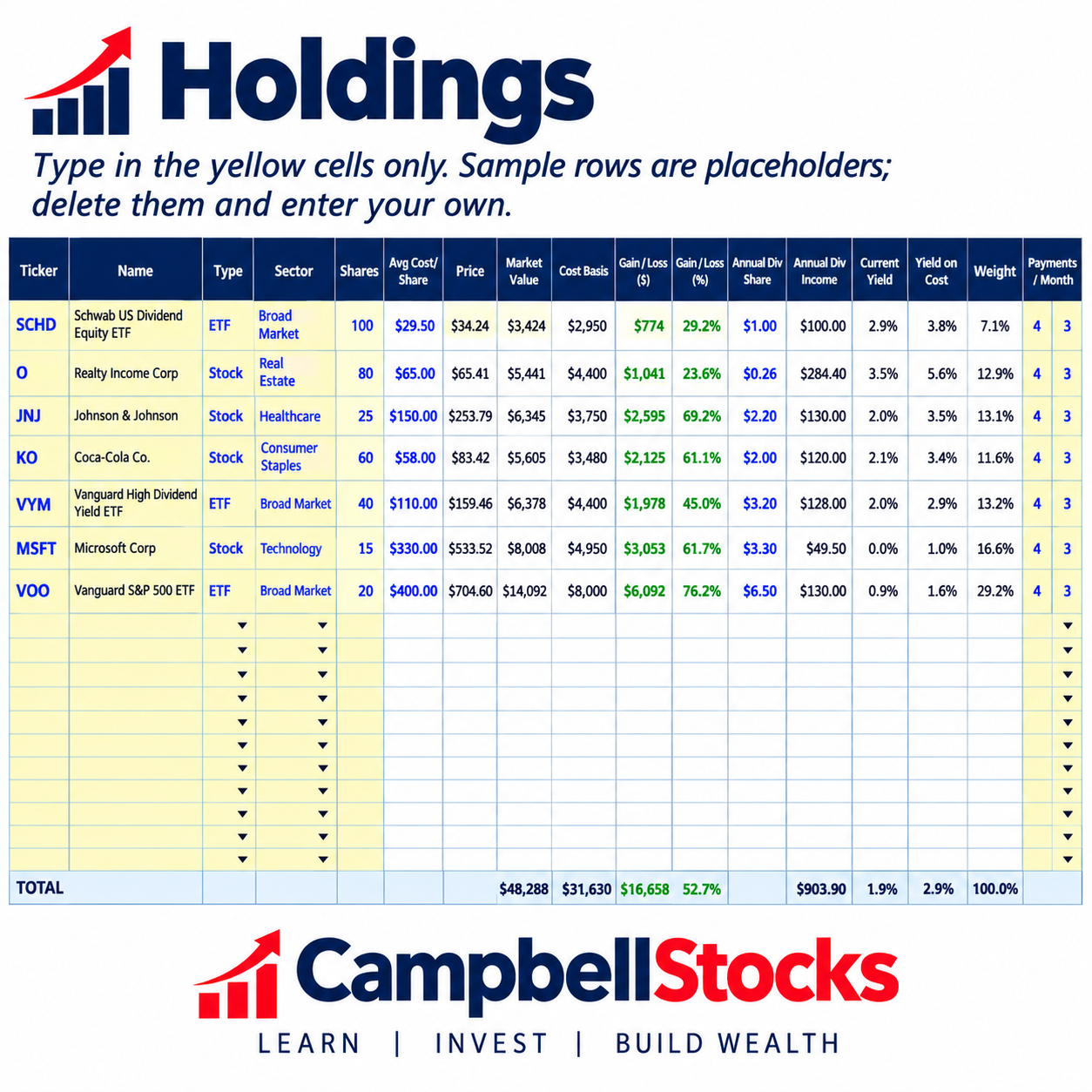
Dividend stocks and ETFs can pay on different schedules, and their yields and distributions can change over time. Tracking your investments can help you see your expected income, review your holdings and understand how concentrated your portfolio is by sector.
I created a Google Sheets tracker with live prices and a 12-month dividend calendar to help you organise your portfolio and monitor estimated dividend income.
CampbellStocks Investing Tool
Dividend & Portfolio Tracker for Google Sheets
Track live prices, organise your holdings and view your estimated dividend income with a practical Google Sheets tool.
Final Thoughts
Dividend ETFs and individual dividend stocks can both play a role in an income-focused portfolio. ETFs offer a convenient way to spread investments across multiple companies, while individual stocks provide greater control but require more research and monitoring.
Rather than choosing based on dividend yield alone, compare costs, diversification, business quality and the sustainability of income. Choose an approach that fits your circumstances and remember that neither investment type guarantees returns or protects you from losses.
Disclaimer: This article is for educational purposes only and does not constitute investment advice. Investing involves risk, including the possible loss of principal. Fund holdings, fees, company fundamentals and dividend policies can change. Review current information and consider consulting a qualified financial professional before investing.