

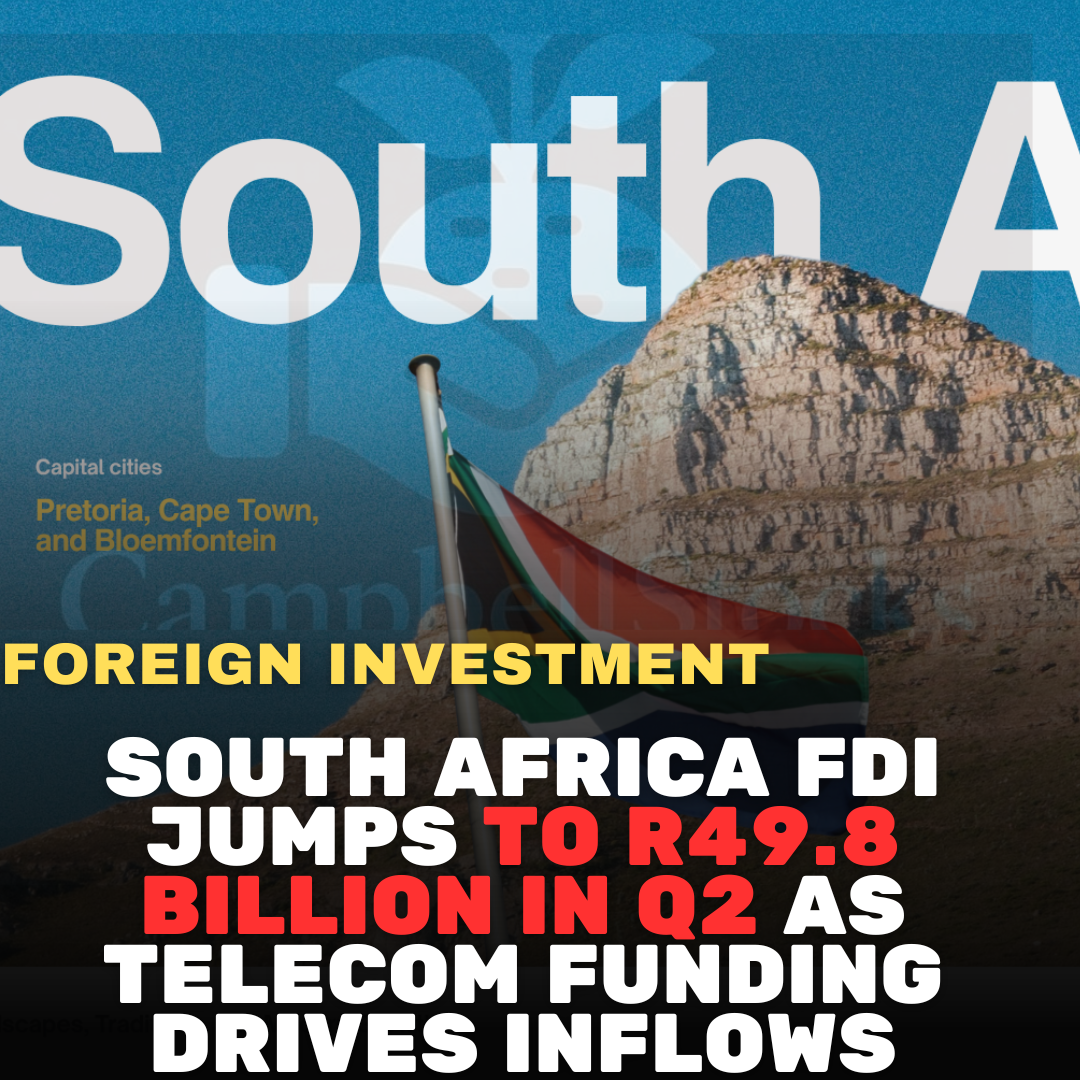
South Africa recorded R49.8 billion ($3.03 billion) in foreign direct investment inflows in the second quarter of 2026, more than double the R20.3 billion recorded in the first quarter. The increase was largely driven by debt funding received by a local telecommunications company from its foreign parent, according to the South African Reserve Bank.
South Africa's foreign direct investment (FDI) inflows rose sharply between April and June, according to the Reserve Bank's September 2026 Quarterly Bulletin released on Tuesday.
The R49.8 billion inflow represented an increase of R29.5 billion from the first quarter. The central bank said the increase resulted primarily from a local telecommunications company receiving debt funding from a non-resident parent company.
The Reserve Bank did not identify the telecommunications company because the transaction had not been made public.
Portfolio investment moves into outflow
While direct investment increased, South Africa experienced an outflow of portfolio investment during the same period. Portfolio investment switched to a R9 billion outflow in the second quarter, compared with a R9 billion inflow during the first quarter.
Foreign investors sold R34.2 billion of South African equity securities during the quarter, while purchasing R25.1 billion of domestic debt securities, according to the Reserve Bank.
The figures show a different pattern between longer-term direct investment and portfolio flows during the quarter. FDI generally involves investment in businesses or productive assets, while portfolio investment includes purchases and sales of financial securities such as shares and bonds.
Bond redemption affects capital flows
The increase in foreign purchases of South African debt securities was partly offset by the national government's redemption of a $1.25 billion international bond, the Reserve Bank said.
On a net basis, the country's financial account recorded a R1.9 billion capital inflow in the second quarter, reversing a R23.1 billion outflow in the first quarter. The financial account captures cross-border transactions involving investments and other financial assets and liabilities.
South African economy contracts in Q2
The increase in FDI came against a weaker domestic economic backdrop. South Africa's real gross domestic product contracted by 0.2% in the second quarter of 2026, following six consecutive quarters of expansion, according to the Reserve Bank.
The central bank attributed the contraction partly to weaker activity in the primary and secondary sectors. Mining output declined, while manufacturing contracted for a fourth consecutive quarter.
The country's official unemployment rate also increased to 33.6% in the second quarter as the number of officially unemployed people rose by 345,000.
Despite the quarterly economic contraction, the Reserve Bank reported that real gross fixed investment during the first half of 2026 was 0.8% higher than in the corresponding period of 2025.
What the FDI figure means for investors
The R49.8 billion FDI figure highlights a substantial increase in foreign direct capital entering South Africa during the second quarter. However, the Reserve Bank's explanation indicates that the increase was heavily influenced by a specific telecommunications transaction rather than a broad-based increase across all sectors.
At the same time, foreign investors reduced their exposure to South African equities during the quarter, selling R34.2 billion of domestic shares while increasing their holdings of domestic debt securities.
The latest data therefore provides a mixed picture of foreign capital flows: direct investment increased significantly, while portfolio investment moved into negative territory.
The Reserve Bank's next quarterly data will provide further information on whether the second-quarter increase in FDI was sustained beyond the specific telecommunications transaction.
Other News
Top Stories- 1 U.S. Employers Add Just 29,000 Jobs in September as Unemployment Rises to 4.2%
- 2 Micron Posts Record $54.2 Billion Revenue as AI Memory Demand Drives Chip Boom
- 3 U.S. Treasury Yields Hit Highest Levels Since 2002 as Bond Selloff Deepens
- 4 Singapore Pays Citizens to Read Books for 15 Minutes a Day to Fight ‘Brain Rot’



Comments (0)
You must be logged in to post comments.
No comments yet. Be the first to start the conversation!