

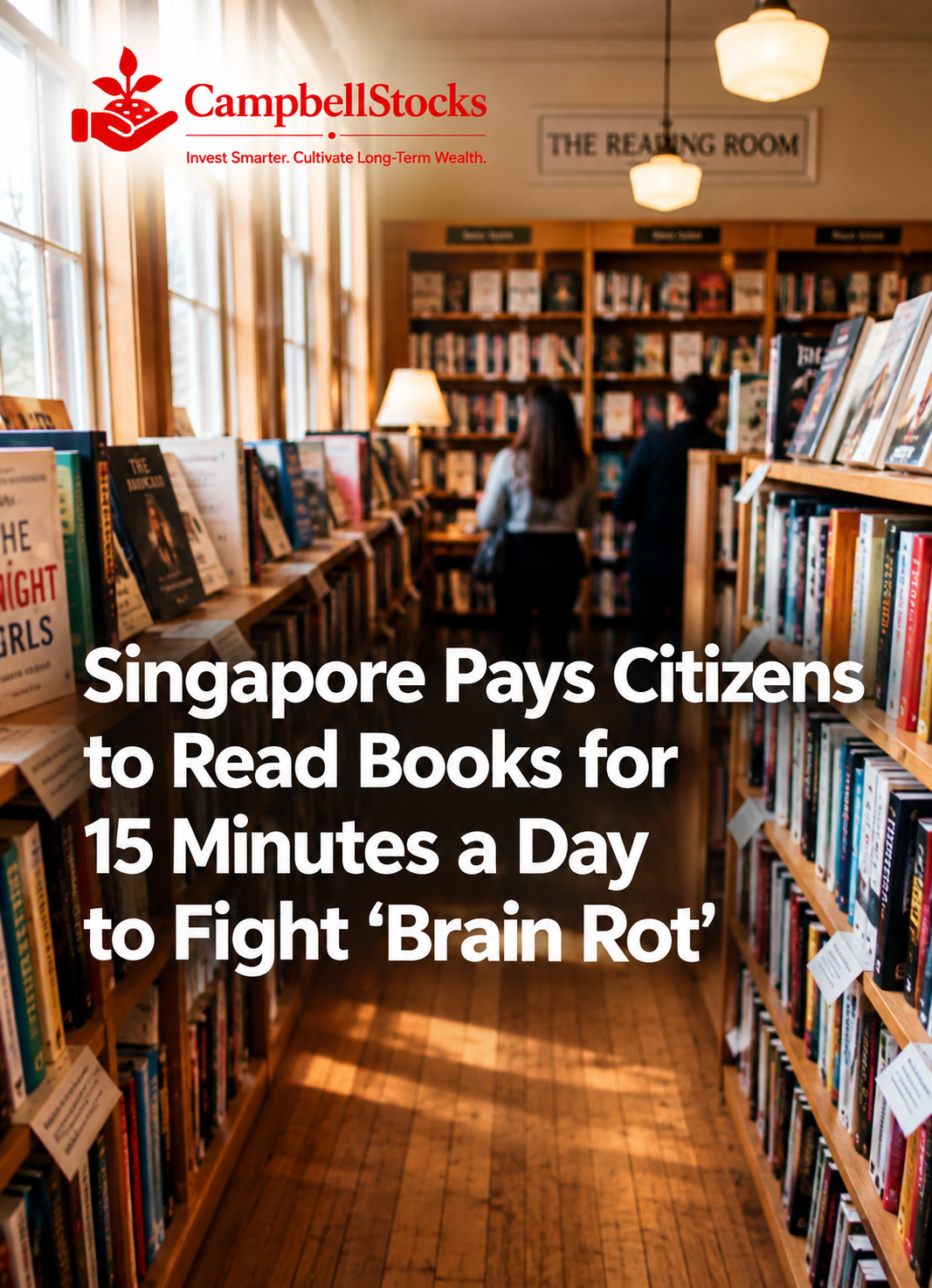
Singapore has launched a five year national reading initiative that rewards participants with virtual coins for reading for at least 15 minutes a day. The program, called ReadSG, is designed to strengthen reading habits, focus and critical thinking at a time when people increasingly consume short form digital content.
Singapore has launched a national campaign that gives citizens small financial rewards for spending at least 15 minutes a day reading, as the government seeks to strengthen reading habits in an increasingly digital environment.
The initiative, called ReadSG, was launched by Singapore’s National Library Board (NLB) on September 6 as part of the country's first National Reading Month. It is planned as a five year national movement aimed at making reading a regular habit and building a stronger reading culture.
Under the ReadSG Challenge, participants can record one reading session of at least 15 minutes each day through Singapore's government citizen engagement platform, CrowdTaskSG. Each qualifying session earns 20 virtual coins.
The coins have a cash value, with 1,000 coins equivalent to S$1. That means a qualifying 15-minute reading session is worth just S$0.02, while participants would need 50 such sessions to accumulate S$1. The program is therefore designed primarily as a behavioral incentive rather than a meaningful source of income.
The reading challenge uses gamification features including reading streaks, personal goals, experience points and redeemable virtual coins. Participants can use the system to track their reading activity and build a consistent daily routine.
Melissa Tam, chief executive of Singapore's National Library Board, said the abundance of digital content means people can spend their time scrolling through headlines, watching videos or consuming summaries rather than engaging deeply with longer material.
The NLB says reading can help strengthen the ability to focus, think critically, imagine and make sense of the world. Its official ReadSG campaign describes the objective as developing curious minds, critical thinkers and informed citizens.
The term “brain rot” has increasingly been used in popular discussion to describe the perceived effects of excessive consumption of low-value or highly repetitive digital content. However, the term is not a medical diagnosis, and Singapore's program is not presented by the NLB as a medical treatment for a condition called brain rot.
One of them is Read for Good, running from September 6 to October 7. Participants' logged reading contributes toward a collective target of 7.5 million reading minutes, which can unlock up to S$150,000 in funding for participating beneficiaries, according to program information reported by Singapore media.
Singapore is also holding its annual Big Book Giveaway on September 19 and 20, when members of the public can take home pre-loved books from the National Library Board's collections free of charge. The event allows each participant to take up to 10 books, subject to availability.
The broader campaign also includes reading events and programs intended to address what NLB calls the modern “attention economy,” including discussions about reading in an environment dominated by digital distractions.
Singaporean 15-year-olds ranked first globally in reading in the latest PISA assessment, according to recent reporting on the ReadSG initiative. That suggests the government's campaign is focused less on correcting a collapse in reading ability and more on maintaining and strengthening reading as a long-term habit among the wider population.
The unusual incentive has nevertheless attracted international attention because of its simple proposition: citizens can earn a small financial reward for putting down their phones and reading for 15 minutes.
At S$0.02 per daily session, the financial return is modest. The larger objective is behavioral, encouraging people to establish a regular reading routine and spend more time with longer-form content.
For Singapore, ReadSG represents an experiment in using gamification, public participation and small financial incentives to encourage a traditional habit in an increasingly digital society.
Other News
Top Stories- 1 U.S. Employers Add Just 29,000 Jobs in September as Unemployment Rises to 4.2%
- 2 Micron Posts Record $54.2 Billion Revenue as AI Memory Demand Drives Chip Boom
- 3 U.S. Treasury Yields Hit Highest Levels Since 2002 as Bond Selloff Deepens
- 4 Jimmy Kimmel Criticizes FCC Over Rules Blocking ABC Interview With Senate Candidate







Comments (0)
You must be logged in to post comments.
No comments yet. Be the first to start the conversation!