

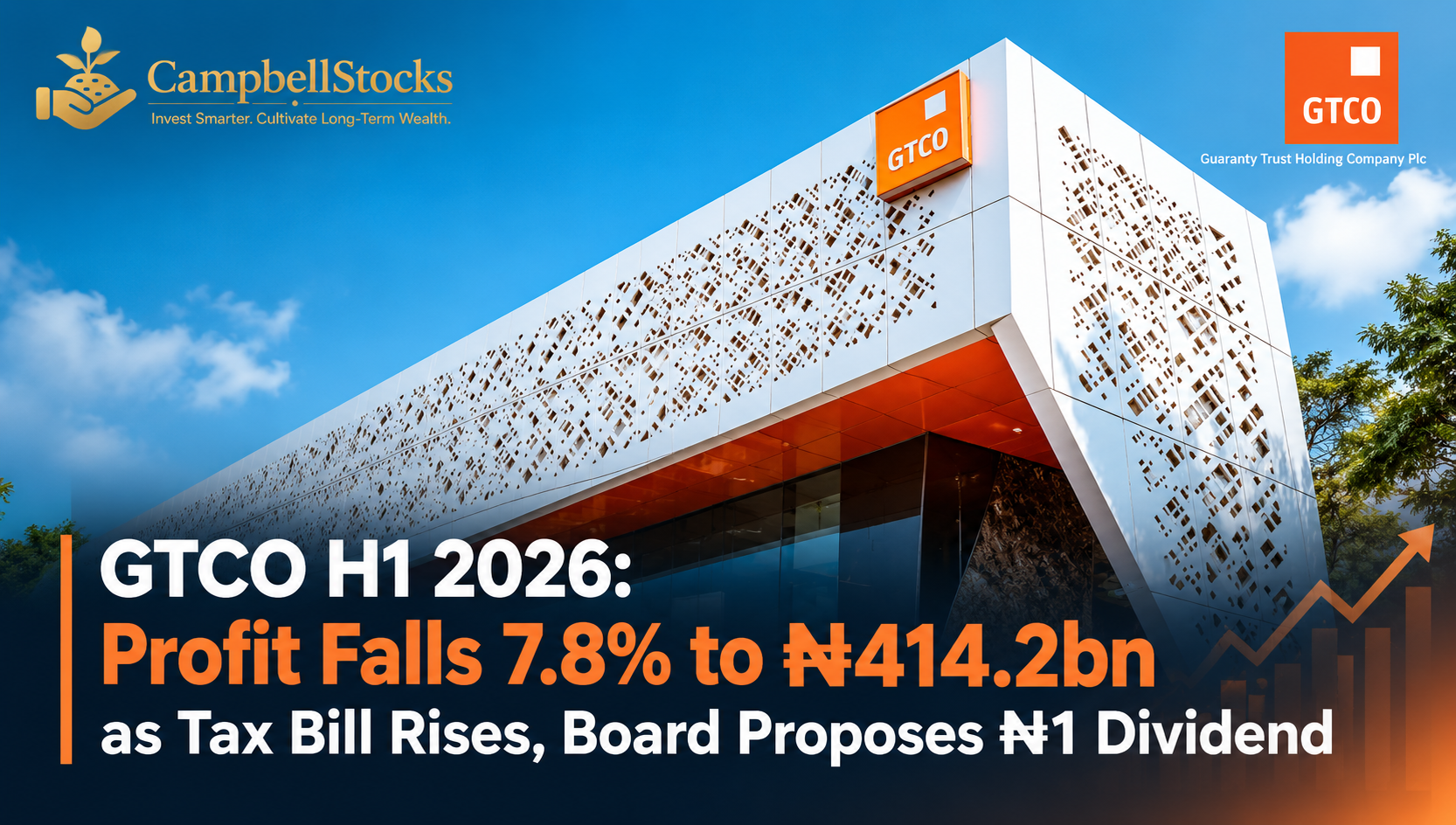
Guaranty Trust Holding Company Plc (GTCO) recorded a marginal increase in profit before tax in the first half of 2026, but higher tax expenses pushed profit after tax down 7.8% to ₦414.2 billion.
Guaranty Trust Holding Company Plc (GTCO) held its pre-tax profit steady in the first half of 2026. A heavier tax charge, softer fee income and a currency driven hit to its foreign subsidiaries still left shareholders with lower earnings than a year earlier.
The group reported profit before tax of ₦603.03 billion for the six months ended 30 June 2026, up 0.4% from ₦600.90 billion in the same period of 2025. Profit after tax fell 7.8% to ₦414.19 billion, from ₦449.01 billion. Basic and diluted earnings per share dropped to ₦11.18 from ₦13.59. The board proposed an interim dividend of ₦1.00 per ordinary share.
Profit attributable to shareholders fell 7.4% to ₦408.54 billion. The main drag was taxation. Income tax expense rose 24.3% to ₦188.85 billion from ₦151.89 billion, an increase of more than ₦36.9 billion. On the reported figures, this lifted the effective tax rate to about 31%, from roughly 25% a year earlier.
Earnings per share fell faster than profit, by about 18%. That appears to reflect a larger share base, since share capital rose to ₦18.28 billion from ₦17.07 billion a year earlier.
Revenue Growth Remains Modest
Gross earnings rose 3.2% to ₦1.11 trillion from ₦1.07 trillion. Net interest income grew 2.8% to ₦649.60 billion, and trading gains rose 24.7% to ₦47.30 billion.
Other revenue lines moved the opposite way:
- Net fee and commission income fell 9.0% to ₦123.03 billion, from ₦135.17 billion.
- Other income dropped 37.5% to ₦44.35 billion, from ₦70.92 billion.
- The group also booked a ₦46.2 billion fair-value loss, which the company said moderated growth in pre-tax earnings.
Lower Credit Costs Protect Pre-Tax Profit
The most important support for pre-tax profit was a sharp fall in credit charges. Loan impairment charges dropped about 66% to ₦18.72 billion, from ₦54.97 billion in the first half of 2025. That helped cushion the weaker fee and other income.
GTCO said its cost of risk improved to 0.6% from 2.2%. It also reported that Stage 3 loans under IFRS 9 stood at 4.6% of the loan book at the end of June, down from 5.0% at the end of 2025.
Second Quarter: Profit Up, but Core Income Softer
For the three months to 30 June, profit before tax was ₦300.14 billion, essentially level with ₦300.64 billion a year earlier. Net profit rose 2.6% to ₦196.06 billion from ₦191.10 billion.
The core income lines were weaker in the quarter:
- Net interest income fell 6.6% to ₦293.31 billion.
- Fee and commission income dropped 18.8% to ₦62.13 billion.
- Loan impairment charges fell 74% to ₦10.77 billion, from ₦41.49 billion in the second quarter of 2025.
The quarterly improvement in net profit therefore came mainly from lower credit costs, not from stronger growth in the group's main revenue streams.
Deposits Surge While Lending Barely Moves
The balance sheet expanded during the half. Total assets rose 4.8% to ₦18.62 trillion from ₦17.76 trillion at the end of December 2025. Customer deposits grew 11.3% to ₦13.97 trillion from ₦12.55 trillion.
Lending did not keep pace. Loans and advances to customers rose just 0.5% to ₦3.15 trillion from ₦3.13 trillion. A large share of the new funding went into investment securities, which increased about 21.9% to ₦6.76 trillion from ₦5.54 trillion. Cash and bank balances fell 13.2% to ₦4.74 trillion.
On the reported figures, the loan-to-deposit ratio was roughly 22.5%. That points to a bank holding ample liquidity but deploying it mainly in securities rather than customer loans.
Nigeria Drives Group Earnings as Foreign Operations Contract
GTCO’s Nigerian operations remained the largest contributor to group earnings in the first half of 2026. Gross earnings from Nigeria increased 11.1% to approximately ₦770.64 billion, while profit before tax rose 2.8% to ₦423.29 billion.
Outside Nigeria, however, gross earnings declined across the group’s major operating regions. Gross earnings from the rest of West Africa, covering Ghana, Gambia, Sierra Leone, Liberia and Côte d’Ivoire, fell 10.3% to ₦279.62 billion. Profit before tax from the region declined 2.2% to ₦165.62 billion.
In the United Kingdom, gross earnings declined 13.2% to ₦27.20 billion, with profit before tax falling 30.4% to ₦7.10 billion. As a result, operations outside Nigeria accounted for about 30.4% of group gross earnings, down from 35.3% in the comparable period.
Operating Costs Rise Faster Than Income
Operating expenses climbed about 7.3% to ₦277.39 billion, outpacing revenue growth. Depreciation and amortisation rose 41.8% to ₦54.31 billion, the sharpest increase among the cost lines. Personnel expenses grew 4.7% to about ₦56.97 billion, while other operating expenses were broadly flat.
Operating costs were roughly 32% of operating income, compared with about 29.5% a year earlier, so cost efficiency weakened modestly.
Capital Ratios Fall but Stay Well Above Requirements
GTCO's capital adequacy ratio stood at 34.86% at 30 June 2026, down from 43.82% at the end of 2025. The Tier 1 ratio was 32.06%, compared with 39.48% six months earlier.
Two factors drove the decline. Risk-weighted assets rose to about ₦7.93 trillion from ₦6.72 trillion, and shareholders' funds fell to about ₦3.32 trillion from ₦3.41 trillion. Interim dividend payments and foreign-currency translation effects both contributed to the drop in equity.
Currency Losses Deepen the Fall in Comprehensive Income
Total comprehensive income fell to about ₦305.56 billion from ₦540.35 billion in the first half of 2025. A major factor was a foreign-currency translation loss on the group's overseas subsidiaries. The gap between reported profit and comprehensive income shows how exposed a multi-country financial group is to exchange-rate movements when it consolidates its foreign operations.
Strong Cash Generation Funds Large Securities Purchases
Operating cash flow was about ₦1.19 trillion, up from ₦372.0 billion a year earlier, largely because of the rise in customer deposits. Investing activities used about ₦1.49 trillion, reflecting heavy purchases of investment securities. Financing activities used about ₦502.3 billion, including roughly ₦429.8 billion in dividends paid to shareholders. Cash and cash equivalents ended the period at about ₦4.14 trillion.
Asset Management Business Expands
The group's non-bank businesses also grew. Assets under management at Guaranty Trust Fund Managers rose to about ₦754.6 billion from ₦449.4 billion at the end of December 2025. The money market fund saw the strongest growth, with assets rising from about ₦301.2 billion to ₦546.6 billion. The expansion supports GTCO's strategy of building a financial services platform spanning banking, payments, pension administration and asset management.
Outlook: What Investors Will Watch
The first-half results present a mixed picture. GTCO kept pre-tax profit stable, grew its balance sheet and cut credit costs, and the interim dividend gives shareholders a direct return. Growth was narrow, though. Fee income and other income fell, expenses rose, and every foreign market except Nigeria reported lower earnings.
Taxation was the largest single pressure on the bottom line, turning a 0.4% rise in pre-tax profit into a 7.8% fall in net profit. Going forward, investors will focus on whether GTCO can turn its growing deposit base into higher-yielding assets, rebuild fee income, contain cost growth and stabilise its foreign operations.
Figures are drawn from GTCO's audited financial statements for the half-year ended 30 June 2026
Other News
Top Stories- 1 U.S. Employers Add Just 29,000 Jobs in September as Unemployment Rises to 4.2%
- 2 Micron Posts Record $54.2 Billion Revenue as AI Memory Demand Drives Chip Boom
- 3 U.S. Treasury Yields Hit Highest Levels Since 2002 as Bond Selloff Deepens
- 4 Singapore Pays Citizens to Read Books for 15 Minutes a Day to Fight ‘Brain Rot’




Comments (0)
You must be logged in to post comments.
No comments yet. Be the first to start the conversation!