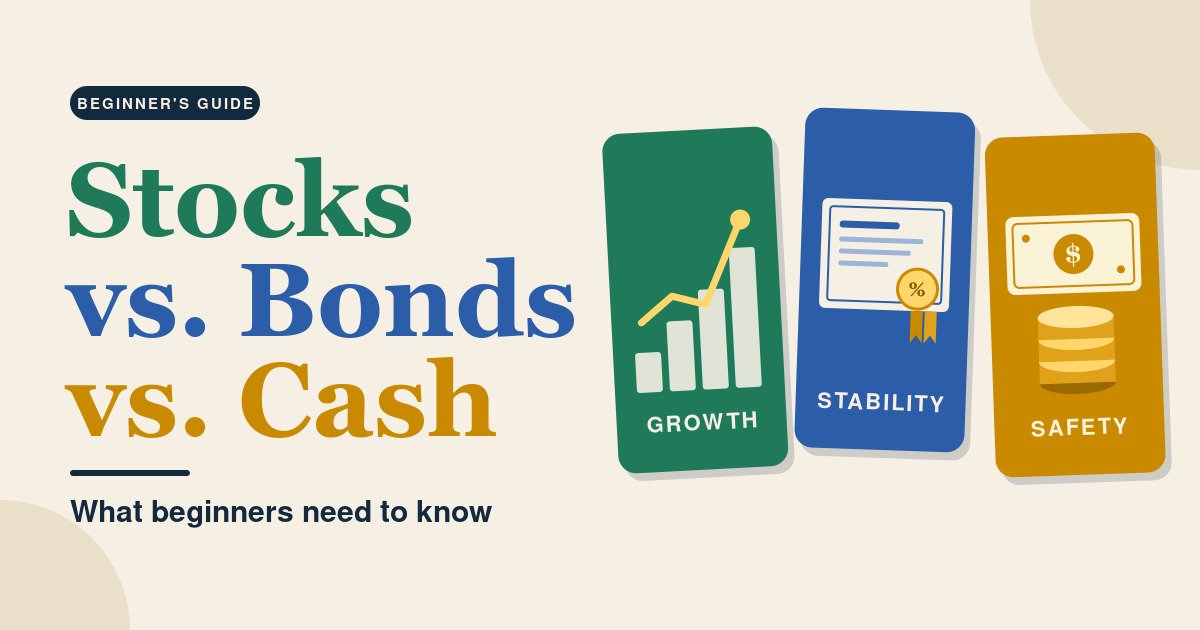
Confused about stocks vs. bonds vs. cash? Learn how each asset class works, their historical returns, risks, inflation impact, and how to balance them in your portfolio.
Almost every money conversation comes down to three building blocks: stocks, bonds, and cash.
In the investing world, these are called asset classes. Every mutual fund, Exchange-Traded Fund (ETF), retirement plan, and robo-advisor portfolio is built from some mix of them. Yet for beginners, knowing where to put your hard-earned money, and why, can feel overwhelming.
Keep everything in cash, and inflation quietly erodes your purchasing power. Put everything in stocks, and a sudden downturn might tempt you to panic-sell at the worst moment. Rely only on bonds, and your wealth may not grow fast enough to fund a comfortable retirement.
This guide explains each asset class in plain English, compares their risks and historical returns, and shows you how to combine them based on your timeline and goals. New to all this? It also helps to understand how the stock market actually works first.
The 30-Second Version
Cash protects money you need soon.
Bonds add income and steady the ride.
Stocks grow your money over the long run.
The right mix depends on when you will need the money, not on which asset sounds best.
Stocks vs. Bonds vs. Cash at a Glance
Here is a side-by-side snapshot of how the three compare on the factors that matter most to everyday investors.
Important: Historical returns are illustrative long-term estimates, not guaranteed future performance. Actual returns vary by market, time period, inflation, fees, and investment selection.
1. Cash: Safety, Liquidity, and the Silent Threat of Inflation
Everyone understands cash. It is the money in your wallet, checking account, high-yield savings account (HYSA), certificate of deposit (CD), or money market fund. In finance these are grouped as cash and cash equivalents because you can access them quickly with very little risk of losing your principal, depending on the instrument and account protections.
Cash is your financial shock absorber. If your car breaks down, your roof leaks, or you lose your job, you cannot wait days for investments to settle or sell stocks in a crash just to pay rent. Cash gives you liquidity (quick access) and certainty. For example, $1,000 in a federally insured bank account will still read $1,000 next Tuesday.
The Hidden Risk of Holding Too Much Cash
Cash feels completely safe, but holding too much for too long carries a silent risk: inflation.
Inflation in Action
A basket of groceries costs $100 today. At 3% inflation a year, the same basket costs roughly $134 in ten years. If your cash sits in a checking account earning 0.01%, your balance stays at $100, but what it can buy shrinks every year.
2. Bonds: Predictable Income and Portfolio Stability
If stocks are the engine of a portfolio, bonds are the brakes and suspension. When you buy a bond, you are not buying ownership in a company. You are acting as the lender.
How Bonds Work
Governments, cities, and corporations constantly need money to build highways, fund schools, or expand factories. Instead of borrowing it all from one bank, they issue bonds to investors. When you buy one, you lend money under three contractual terms:
- Principal (par value): the amount you lend, commonly $1,000 per bond.
- Coupon rate: the interest rate the borrower agrees to pay you, usually twice a year, for using your money.
- Maturity date: the date the borrower is scheduled to repay your principal, ranging from a few months to 30 years.
Example
Buy a 10-year, $1,000 government bond with a 4% coupon and you receive $40 a year in interest for ten years. At the end of year ten, the government returns your original $1,000, assuming it meets its repayment obligations.
The Main Types of Bonds
The Risks of Bonds
Bonds are generally less volatile than stocks, but they are not risk-free:
- Interest rate risk. Bond prices and interest rates generally move like a seesaw. If you own a bond paying 3% and new bonds pay 5%, yours becomes less attractive and may have to be sold at a discount.
- Inflation risk. Lock in a fixed 4% for 20 years, and if inflation surges to 6%, the buying power of your interest checks declines.
- Credit/default risk. If a struggling company or government fails to meet its obligations, it may miss interest payments or fail to repay principal.
3. Stocks: The Engine of Long-Term Wealth
Stocks (also called equities) represent fractional ownership in a publicly traded company. When you buy a share of Amazon, Visa, or Johnson & Johnson, you become a shareholder and own a small part of that business.
Related Article
How Stocks Make You Money
Unlike bonds, stocks come with no guarantees and no maturity dates. You build wealth in two ways:
- Capital appreciation. As a company invents better products, wins more customers, and grows profits, the value of the business may grow and its share price may rise.
- Dividends. Many established, profitable companies share part of their earnings with shareholders. Reinvesting those dividends to buy more shares can create a powerful compounding effect.
Why Stocks Have Historically Outperformed Bonds and Cash
Over long periods, the broad U.S. stock market (such as the S&P 500 Index) has delivered average annual returns of roughly 8% to 10% before inflation, although results vary by the period measured.
Why the higher potential return? The risk-reward trade-off. Stockholders rank behind creditors and bondholders if a company runs into trouble. Bondholders have contractual claims, while shareholders benefit if the business grows. Investors accept short-term uncertainty in exchange for higher long-term growth potential.
The Risks of Stocks
- Market volatility. Prices move with earnings reports, economic news, interest rates, and investor sentiment. Markets can suffer corrections and major declines, sometimes over short periods.
- Individual company risk. Even giants can lose their edge (think Kodak, Blockbuster, or Sears). Beginners can reduce company-specific risk with broad-market index funds or ETFs, which spread money across hundreds of companies instead of relying on one.
Real-World Example: $10,000 Over 20 Years
Numbers make the difference clear. Imagine three beginners each start with $10,000 and leave it untouched for 20 years.
Investor A: Cash at 2%
Investor B: Bonds at 4.5%
Investor C: Stocks at 8.5%
- Investor A never sees a red day on the statement, but after average inflation of 2.5% to 3%, actually loses purchasing power.
- Investor B enjoys a smoother ride and more than doubles the nominal balance.
- Investor C lives through several market declines but, by staying invested, ends with more than double Investor B's money and more than triple Investor A's.
These are hypothetical illustrations based on constant annual compound returns, before taxes, fees, and inflation. Actual returns are variable and not guaranteed.
How to Decide Your Mix: Asset Allocation for Beginners
You do not have to choose only stocks, only bonds, or only cash. Successful investors often combine all three in a strategy called asset allocation, dividing money across asset classes so each plays its own role.
The right mix depends mostly on your time horizon (when you need to spend the money) and your risk tolerance (how well you sleep when the market drops).
Short-Term Goals (0 to 2 Years)
Illustrative mix: 100% cash
Where: high-yield savings, money market funds, or short-term CDs.
Why: When you need money soon, such as an emergency fund, wedding budget, or house down payment, protecting your principal comes first. You cannot afford a sudden 25% stock drop right before closing on a home.
Medium-Term Goals (3 to 7 Years)
Illustrative mix: 40% to 60% bonds and 40% to 60% stocks, plus a small cash buffer. The bar shows the midpoint.
Why: A balanced mix lets your money grow while bonds cushion the impact if stocks hit a rough patch before you need the funds.
Long-Term Goals (10+ Years, Such as Retirement)
Illustrative mix: 80% to 90% stocks and 10% to 20% bonds, outside your separate emergency cash fund. The bar shows the midpoint.
Why: With a decade or more before you touch the money, crashes may be temporary setbacks rather than permanent losses. Time gives stocks room to recover and compound. As retirement approaches, you may gradually shift more into bonds and cash to reduce risk.
Stocks Bonds Cash
Important: These mixes are illustrations, not personal recommendations. Your own mix should reflect your goals, timeline, and tolerance for risk.
Frequently Asked Questions
Tap any question to reveal the answer.
Final Thoughts: Three Teammates, Three Jobs
Stocks, bonds, and cash are not rivals. They are teammates with completely different jobs:
By matching each dollar to the timeline you plan to spend it, you can make more informed decisions, avoid emotional investing mistakes, and put every asset class to work toward your goals.
Disclaimer: This article is for educational purposes only and does not constitute investment advice. Investing involves risk, including the possible loss of principal. Returns, rates, and allocations shown are illustrations and are not guaranteed. Review current information and consider consulting a qualified financial professional before investing.
This article is for general information and education only. It is not financial, investment, tax or legal advice. Markets carry risk, so do your own research or speak to a licensed adviser before you invest.