
Discover how reading investing, history, and psychology books builds emotional resilience, sharpens mental models, and stops you from panic selling in market crashes.
When red numbers flash across trading screens and breaking news alerts warn of an impending crash, the human brain goes into survival mode. Evolution wired us to run when we sense danger. In the financial markets, however, running (selling quality assets at the bottom) is one of the fastest ways to destroy long-term wealth.
Most investors think their biggest enemy is inflation, interest rate hikes, or poor stock picking. In reality, your greatest financial threat is often emotional reaction during a downturn.
While social media feeds and 24-hour financial news networks profit from your anxiety, deep, deliberate reading does the exact opposite. Reading investing, history, and psychology books helps build an emotional immune system that protects you from market panic.
Here is how trading doomscrolling for chapters can help protect your portfolio when the market inevitably drops.
1. The Biology of Market Panic (And Why News Makes It Worse)
To understand why books protect you, you first need to understand what happens to your brain during a market sell-off.
When your portfolio drops 15% or 20%, your amygdala, the brain’s fear center, can override your prefrontal cortex, which handles logical, long-term planning. You experience physical stress. Your brain screams at you to do something to stop the pain, and the easiest action available on a modern brokerage app is hitting the “Sell” button.
Modern financial media pours gasoline on this biological fire. Headlines are engineered for clicks, not clarity. Phrases like “Markets in Freefall,” “Billions Wiped Out,” and “Is This 2008 All Over Again?” trigger an immediate urgency bias. Even short-form social media posts from anonymous traders amplify herd mentality, making you feel foolish for holding onto your investments while everyone else claims to be cashing out.
Why Books Work
Books operate on a completely different clock.
An author spends years researching, writing, and editing a single book. Because books are insulated from daily market noise, reading one forces your brain to slow down. It helps shift you out of reactive, emotional thinking (System 1) and back into analytical, deliberate thinking (System 2). Simply sitting down with a physical book or e-reader for thirty minutes during a volatile trading day can calm your nerves and interrupt the urge to make impulsive trades.
2. Historical Perspective: Realizing “This Time” Isn’t Different
Sir John Templeton famously noted that the four most dangerous words in investing are “This time it’s different.”
When you only follow daily market news, every crisis feels unprecedented. Whether it is a sudden spike in inflation, a geopolitical conflict, a banking scare, or a tech sector correction, short-term commentary frames the event as a unique, existential threat to the global economy.
Reading financial history shatters that illusion.
When you read books like A Random Walk Down Wall Street by Burton Malkiel, The Psychology of Money by Morgan Housel, or Devil Take the Hindmost by Edward Chancellor, you discover a comforting truth: markets have survived far worse than whatever is happening today.
Through historical reading, you learn that:
- Volatility is the entry fee, not a fine: Over the past century, stock markets have endured world wars, pandemics, double-digit inflation, oil embargoes, and multiple depressions. Historically, diversified equity markets have recovered from each of these and gone on to reach new highs, although recovery can take years.
- Bear markets are normal: A 10% correction happens roughly once every year or two. A 20% bear market happens every few years. Knowing these statistics from books turns a terrifying surprise into an expected event.
- Recovery often begins when sentiment is worst: History shows that some of the biggest single-day market gains happen in the middle of bear markets, often days after the most pessimistic headlines are published.
If you have read about the Panic of 1907, the 1970s stagflation era, the 1987 Black Monday crash, and the 2008 Global Financial Crisis, a 12% market dip in the current year loses much of its power to terrify you. You recognize the pattern, take a breath, and stay invested.
3. Building Mental Models Before the Storm Hits
You cannot learn how to swim while you are drowning, and you cannot build an investing philosophy in the middle of a market crash.
Reading books equips you with mental models, pre-built frameworks for making decisions under pressure. Legendary investors like Charlie Munger and Warren Buffett have long credited their calm during crashes to a latticework of mental models built from thousands of hours of reading, rather than to raw intelligence alone.
Three Core Mental Models You Gain From Investing Books
| Book Concept | Author / Source | How It Stops Panic Selling |
|---|---|---|
| Mr. Market | Benjamin Graham (The Intelligent Investor) | Teaches you to view daily stock prices as the mood swings of an emotional business partner rather than an accurate measure of a company’s true worth. |
| Economic Moats | Pat Dorsey (The Little Book That Builds Wealth) | Reminds you that great businesses with durable competitive advantages tend to survive downturns and can take market share from weaker competitors. |
| Margin of Safety | Seth Klarman / Benjamin Graham | Gives you confidence that because you bought assets below their intrinsic value, short-term price drops are less likely to become permanent losses of capital. |
When you internalize Benjamin Graham’s Mr. Market allegory, a sudden drop in share prices no longer feels like a loss. Instead, it looks like an irrational neighbor offering to sell you his half of a thriving business at a massive discount because he woke up in a bad mood. Want to see how Graham’s classic holds up? Browse our reviews on the CampbellStocks Bookshelf. .
Without reading, a red screen looks like danger. With the right mental models, a red screen looks like a clearance sale.
4. Separating Price From Business Value
One of the biggest drivers of investor panic is confusing a company’s stock price with its underlying business.
In the short term, stock prices move based on liquidity, fear, interest rate expectations, and algorithmic trading. In the long term, stock prices tend to follow earnings and cash flow. Books by value investors, such as Peter Lynch’s One Up On Wall Street and Lawrence Cunningham’s The Essays of Warren Buffett, hammer this distinction home page after page.
What Happens During a Broad Market Sell-Off
- Macroeconomic news hits the wire (for example, hotter-than-expected inflation data).
- Index funds and algorithmic traders sell baskets of stocks indiscriminately.
- A profitable, debt-free consumer goods company or leading bank sees its share price drop 18% in three weeks, even though people are still buying its products every single day.
The investor who does not read looks at the 18% drop and thinks, “Something must be wrong with this company. I need to get out before it goes to zero.”
The investor who has read Peter Lynch checks the company’s fundamentals. They ask: Are customers still using the service? Is the balance sheet still strong? Has the long-term thesis changed? When the answer is no, they hold, or quietly buy more shares at a lower valuation.
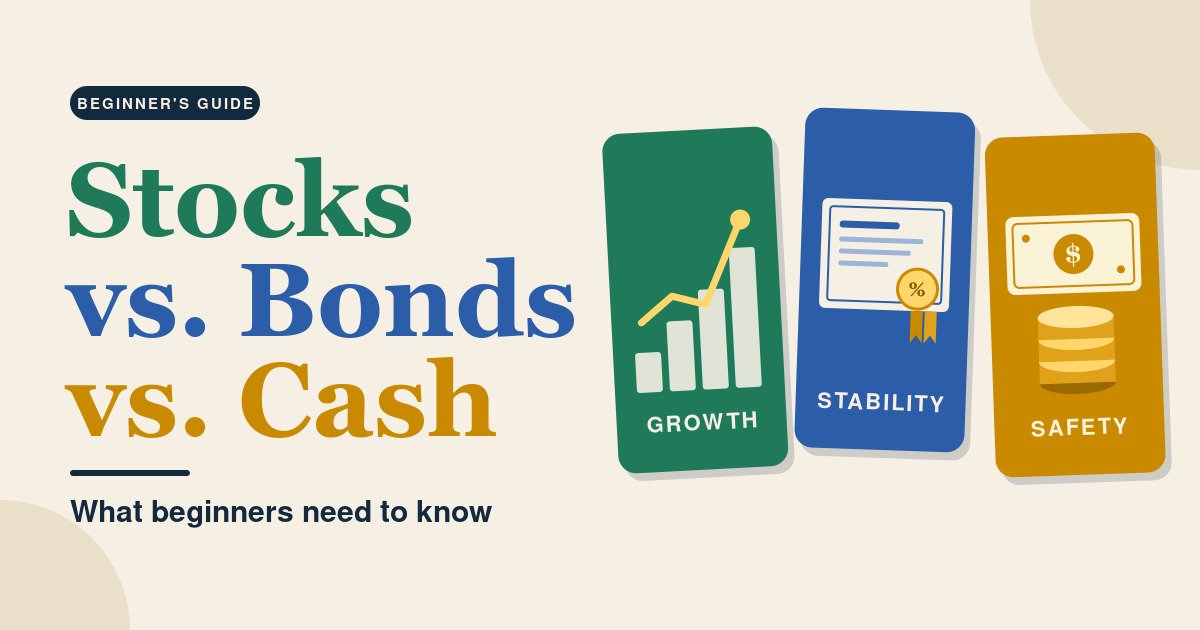
Asset allocation matters here too. Understanding how your money is split between growth and safety makes drops easier to stomach, so it is worth learning the basics of Stocks vs. Bonds vs. Cash before the next downturn arrives. And if you have not started yet, here is How to Open Your First Brokerage Account.
5. Developing Emotional Detachment Through Behavioral Finance
Sometimes the most protective books for your portfolio are not about balance sheets or valuation formulas at all. They are about human psychology.
Behavioral finance books like Daniel Kahneman’s Thinking, Fast and Slow and Jason Zweig’s Your Money and Your Brain expose the hidden cognitive traps wired into our minds. When you can name a psychological bias in real time, it loses much of its grip on your behavior.
- Loss aversion: Kahneman and Tversky’s research suggests the pain of losing money is roughly twice as powerful as the pleasure of gaining the same amount. Recognizing loss aversion helps you realize that your urge to sell isn’t based on financial logic. It’s your brain trying to avoid emotional discomfort.
- Recency bias: Humans naturally assume that whatever happened last week will continue forever. When markets fall for four straight weeks, recency bias tricks you into believing they will keep falling indefinitely. Books remind you that markets move in cycles, not straight lines.
- Action bias: When stressed, humans feel compelled to act. In sports, research on penalty kicks suggests goalkeepers dive left or right even though staying in the center may save more goals. In investing, sitting on your hands during a crash feels unnatural, yet history suggests that inactivity is often the better strategy.
6. How to Build a “Panic-Proof” Reading Habit
You do not need to read fifty books a year to become a calmer, more resilient investor. Even twenty pages a day builds massive compounding knowledge over time.
If you want to use reading as a shield against market volatility, follow this practical four-step routine:
Step 1: Replace Morning Market Checks With 15 Minutes of Reading
Avoid checking stock prices or financial headlines during the first hour of your day. Read one chapter of a finance, history, or psychology book before looking at a single chart.
Step 2: Keep an “Emergency Re-Read” Shelf
Pick two or three timeless books that always ground your thinking, such as The Psychology of Money, The Intelligent Investor, or The Little Book of Common Sense Investing. When markets drop sharply, pull one off the shelf and re-read your highlighted passages.
Step 3: Write Down Your Takeaways in an Investing Journal
Passive reading fades quickly under stress. After finishing a chapter, write two sentences summarizing how that lesson applies to your own portfolio.
Step 4: Read Outside of Finance
Broaden your perspective with biographies, evolutionary biology, and world history. Understanding how systems adapt, survive shocks, and grow over decades makes you far less fragile when quarterly earnings fluctuate.
Final Thoughts: Your Best Defense Is Between Two Covers
No investor can control central bank decisions, geopolitical shocks, or the daily swings of global stock exchanges. You can, however, control the information you feed your mind.
Every hour spent reading timeless books reduces the emotional noise that causes ordinary investors to buy high and sell low. When the next market downturn arrives, and history suggests it eventually will, the investors who survive and prosper won’t be the ones glued to breaking news alerts. They will be the ones who already read how the story ends.
Frequently Asked Questions
Click any question below to reveal its answer.
Disclaimer: This article is for educational purposes only and does not constitute investment, tax, or legal advice. Historical market patterns do not guarantee future results. Conduct your own research or consult a qualified professional before making investment decisions.
This article is for general information and education only. It is not financial, investment, tax or legal advice. Markets carry risk, so do your own research or speak to a licensed adviser before you invest.