
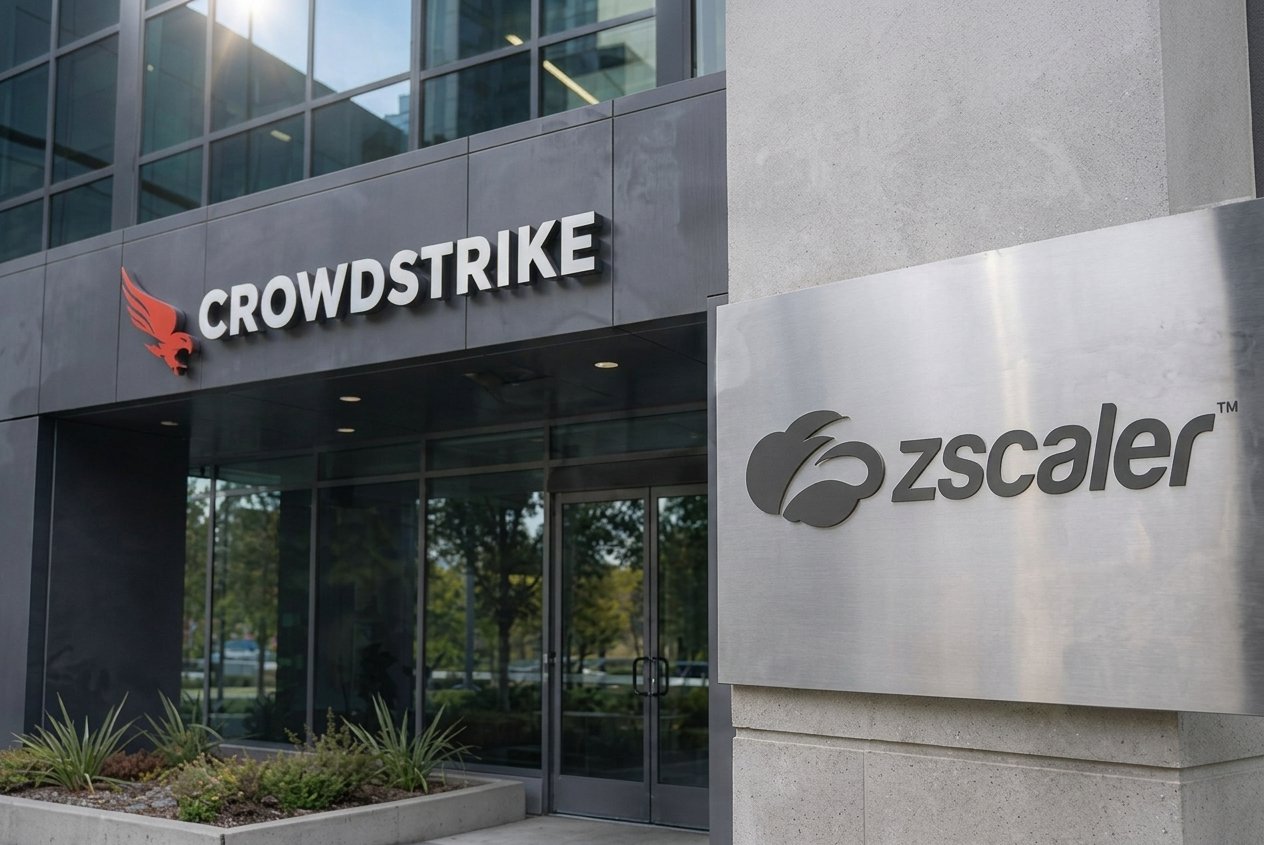
CrowdStrike is acquiring Zscaler in an all-stock deal valued at $43.9 billion to create a unified cybersecurity giant capable of combatting advanced AI threats.
CrowdStrike Holdings has agreed to acquire cloud-security pioneer Zscaler in an all-stock transaction valued at approximately $43.9 billion, the largest acquisition in CrowdStrike’s 16-year history. While headline coverage has focused on the sheer size of the deal amid a record year for tech mergers, the transaction carries major strategic consequences for enterprise software budgets, artificial intelligence defense, and rival platform giants like Palo Alto Networks and Microsoft.
Announced on Monday, November 23, the agreement unites two of the industry’s most influential platforms: CrowdStrike’s Falcon endpoint and cloud-workload protection with Zscaler’s Zero Trust network security architecture. Under the terms unanimously approved by both boards, Zscaler shareholders will receive 1.135 shares of CrowdStrike common stock for each Zscaler share held. Based on Friday’s closing prices, the exchange ratio values Zscaler at $260.41 per share, a roughly 34% premium. Upon completion, existing CrowdStrike shareholders will own approximately 84.1% of the combined company, while Zscaler investors will hold 15.9%.
Why CrowdStrike paid a 34% premium to close its biggest product gap
For investors analyzing CrowdStrike (NASDAQ: CRWD) and Zscaler (NASDAQ: ZS), the deal solves a long-standing strategic vulnerability. Over the past several years, CrowdStrike has built a dominant franchise across endpoint detection, cloud workloads, and identity security. However, network security the industry’s largest spending segment remained its most notable gap.
By absorbing Zscaler, which protects half of the Fortune 500 and processes over 750 billion transactions daily through its Zero Trust Exchange, CrowdStrike gains immediate scale in network defense. More importantly, combining CrowdStrike’s device telemetry with Zscaler’s network traffic data creates a unified data layer to train CrowdStrike’s SafeMind frontier AI security models across an attacker's entire path from initial device breach to lateral network movement.
"Security used to be about keeping the adversary out. Today, safety is required to let AI in," CrowdStrike co-founder and CEO George Kurtz said in Monday’s announcement. "With Zscaler, we’re building cybersecurity’s operating system: a single control plane to deploy AI, control AI, and enable any agentic application to run safely."
Zscaler founder and CEO Jay Chaudhry, who alongside affiliated holders owns roughly 34% of Zscaler and has agreed to vote in favor of the merger, will continue leading the Zscaler unit and join CrowdStrike’s board of directors once the transaction closes.
Reshaping the competitive map against Palo Alto Networks and Google
The acquisition comes amid an unprecedented wave of cybersecurity consolidation triggered by AI-driven cyberattacks and recent high-profile infrastructure outages. Over the past two years, Alphabet’s Google agreed to acquire Wiz for $32 billion, Palo Alto Networks closed its $25 billion purchase of CyberArk alongside a $4.5 billion deal for Applied Compute, and ServiceNow moved to buy Armis for $7.75 billion.
By combining forces, CrowdStrike and Zscaler will launch with more than $10 billion in combined annual recurring revenue (ARR) and expand CrowdStrike’s total addressable market by over $185 billion by 2029. Management also highlighted a massive cross-selling runway: while the two companies already share roughly 2,000 mutual clients, approximately 8,000 Zscaler customers do not yet use CrowdStrike’s platform creating an immediate target list for CrowdStrike’s Falcon Flex subscription contracts.
What investors should watch: dilution vs. long-term synergies
Wall Street’s immediate reaction reflected the classic tug-of-war in mega-cap all-stock mergers: Zscaler shares surged 17.67% to $266.20 on Monday, while CrowdStrike shares dropped 8.92% to $429.40 as investors priced in share dilution and integration timelines.
For equity holders weighing the combined business, three financial benchmarks stand out:
-
Cost and Revenue Synergies: CrowdStrike projects $500 million in annualized run-rate cost savings within 18 to 24 months of closing, largely through data-center and vendor optimization alongside $1 billion in annualized revenue synergies within 30 months.
-
Cash Flow Accretion: Despite near-term stock volatility, management stated the transaction will be immediately accretive to free cash flow per share upon closing, even before factoring in synergies. Both companies also posted strong standalone quarterly beats alongside the deal announcement, with CrowdStrike reporting third-quarter revenue of $1.58 billion and Zscaler posting $949.3 million.
-
Long Regulatory Runway: Because the deal unites two category leaders, closing is not expected until the second half of CrowdStrike’s fiscal year 2028, subject to Zscaler shareholder approval and antitrust clearance.
If regulators clear the tie-up, the combined entity will emerge as a formidable pure-play challenger to Palo Alto Networks in the race to become the primary security backbone for enterprise AI.
Figures and transaction terms are based on CrowdStrike and Zscaler SEC filings, company press releases, and market data as of November 24, 2026. This article is for information only and is not investment advice.
This article is for general information and education only. It is not financial, investment, tax or legal advice. Markets carry risk, so do your own research or speak to a licensed adviser before you invest.
Other News
Top Stories- 1 Dangote Refinery Set for Historic NGX Listing on December 1 After SEC Approves Allotment Plan
- 2 Core PCE Inflation Climbs to 3.3% in October as U.S. Q3 GDP Surges to 4.3%, Sealing December Fed Rate Hike
- 3 U.S. Treasury Yields Edge Lower Ahead of Critical PCE Inflation Report and Holiday Closure
- 4 Dell Revenue Doubles to $54.9 Billion in Q3 as AI Server Backlog Surges to $132.3 Billion






Comments (0)
You must be logged in to post comments.
No comments yet. Be the first to start the conversation!