
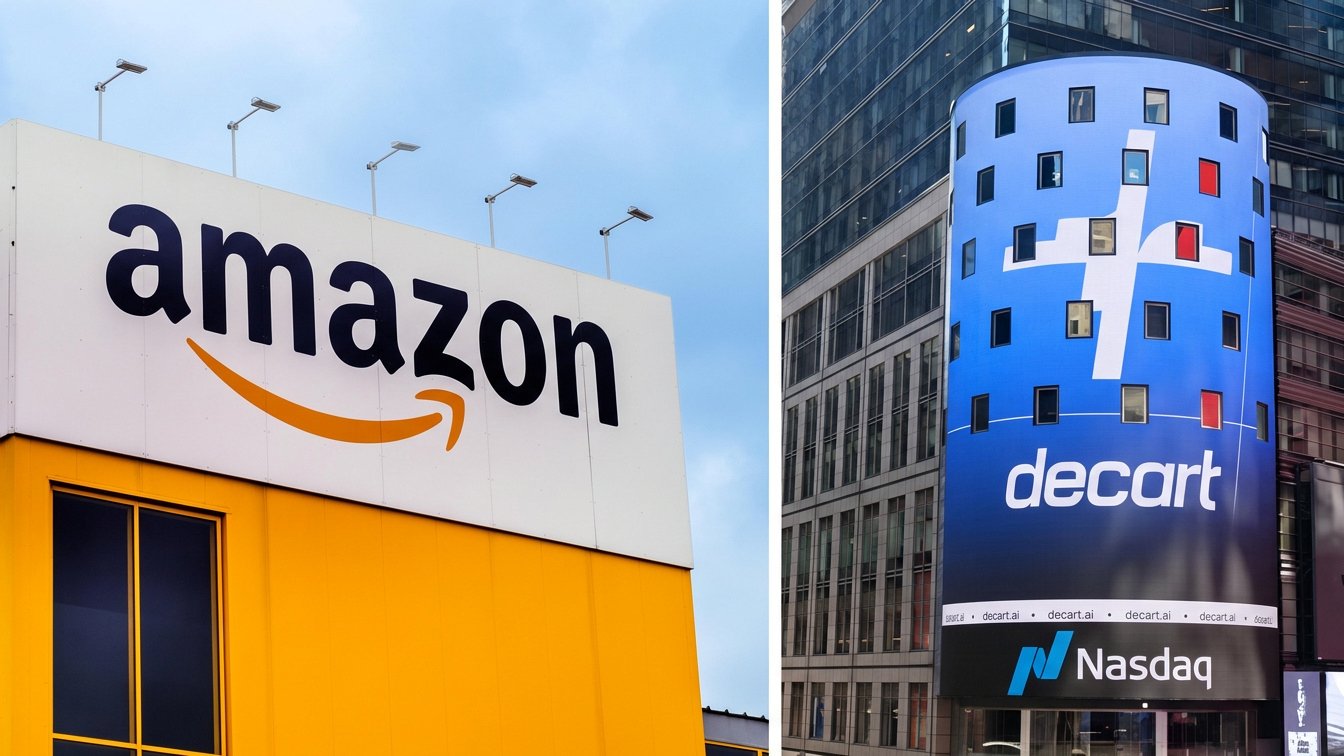
Amazon has agreed to acquire the core AI optimization software, three co-founders, and roughly 120 engineers from Israeli-founded startup Decart in a deal reportedly worth $7.5 billion, targeting Nvidia’s dominance in cloud AI infrastructure.
Amazon has agreed to acquire the core optimization software, three co-founders, and roughly 120 engineers from Israeli-founded artificial intelligence startup Decart in a deal reportedly valued at approximately $7.5 billion. While mainstream headlines have largely grouped the transaction with Big Tech’s recent wave of talent-and-licensing "acqui-hires," the structure of the agreement reveals a much deeper play by Amazon Web Services (AWS) to break Nvidia’s grip on enterprise AI infrastructure.
Announced on Monday, November 23, the deal transfers the intellectual property behind the Decart Optimization Stack (DOS) to Amazon alongside co-founders Dean Leitersdorf, Orian Leitersdorf, and Moshe Shalev. Rather than absorbing the entire startup, Amazon left behind Decart’s consumer-facing generative video and virtual world products, including its Oasis and Lucy models to isolate the underlying systems software that allows developers to train and run massive AI models across different types of computer chips.
Why AWS spent billions on software instead of buying more GPUs
For investors analyzing Amazon (NASDAQ: AMZN), the Decart deal addresses the single largest strategic hurdle facing AWS: convincing corporate customers to run their AI workloads on Amazon’s custom Trainium and Inferentia chips rather than paying steep markups for Nvidia’s flagship GPUs.
For more than a decade, Nvidia’s near-monopoly in AI computing has been protected less by its silicon than by CUDA, its proprietary software platform. Because millions of AI models are written specifically for CUDA, switching an enterprise workload from Nvidia hardware to a rival chip has historically required months of expensive code rewrites and performance trade-offs.
Decart’s software was built specifically to eliminate that friction. By enabling developers to synchronize and optimize models across heterogeneous chip architectures without losing speed, the technology lowers the switching costs for AWS clients migrating onto Amazon’s proprietary hardware.
The engineering team will be integrated into Annapurna Labs, Amazon’s Israel-based semiconductor division, which Amazon bought for roughly $350 million in 2015 and transformed into the engine behind its custom data-center chips. Amazon and Decart had already worked closely together since 2025, with AWS previously disclosing that Decart ran real-time generative video workloads four times faster on Trainium3 processors at roughly half the cost of competing GPUs.
Related Article
FAA Opens Investigation into Amazon Drone Crash Near Detroit After Aircraft Strikes Utility Lines
Inside the bidding war between Amazon, Anthropic, and Nvidia
The agreement brings an end to months of high-stakes negotiations among top AI players. Founded in late 2023 by alumni of Israel’s Unit 8200 military intelligence division, Decart raised $300 million in May 2026 at a $4 billion valuation from prominent venture firms including Sequoia Capital, Benchmark, and Radical Ventures, as well as Nvidia itself.
According to deal reports, AI model developer Anthropic entered advanced negotiations earlier this year to acquire Decart for roughly $6 billion before walking away from the table in September. Decart then explored renewed acquisition talks with Nvidia before Amazon stepped in with a cash-and-stock package tied to multi-year performance milestones. Under the agreement, Decart’s three co-founders who collectively own roughly 64% of the company have committed to staying with Amazon for at least five years.
What this means for AMZN and NVDA investors
From a capital-allocation perspective, the Decart transaction carries three major takeaways for equity investors watching the AI infrastructure race:
-
AWS Margin Protection: Data-center capital expenditures have surged across Big Tech as cloud providers spend tens of billions of dollars annually on Nvidia processors. Every workload AWS shifts onto its in-house Trainium silicon directly improves cloud operating margins and reduces supplier dependence.
-
Pressure on Nvidia’s Software Lock-In: While Nvidia’s hardware remains the industry benchmark, deals that standardize cross-chip compatibility gradually erode the switching barrier that has allowed Nvidia to command industry leading gross margins.
-
Navigating Antitrust Scrutiny: By carving out Decart’s core infrastructure IP and engineering team while leaving the remaining corporate entity independent, Amazon is following the modern Big Tech M&A blueprint, previously used in its 2024 deals with Adept and Covariant designed to capture mission-critical AI capabilities while minimizing prolonged merger blocks.
Even with its selective asset-and-talent structure, Amazon noted that the transaction remains subject to customary regulatory approvals. If cleared, the integration of Decart’s optimization stack gives AWS a sharper commercial weapon to win enterprise AI contracts heading into 2027.
Figures and deal details are based on Amazon’s official announcement and market disclosures as of November 24, 2026. This article is for information only and is not investment advice.
This article is for general information and education only. It is not financial, investment, tax or legal advice. Markets carry risk, so do your own research or speak to a licensed adviser before you invest.
Other News
Top Stories- 1 Dangote Refinery Set for Historic NGX Listing on December 1 After SEC Approves Allotment Plan
- 2 Core PCE Inflation Climbs to 3.3% in October as U.S. Q3 GDP Surges to 4.3%, Sealing December Fed Rate Hike
- 3 U.S. Treasury Yields Edge Lower Ahead of Critical PCE Inflation Report and Holiday Closure
- 4 Dell Revenue Doubles to $54.9 Billion in Q3 as AI Server Backlog Surges to $132.3 Billion



Comments (0)
You must be logged in to post comments.
No comments yet. Be the first to start the conversation!