
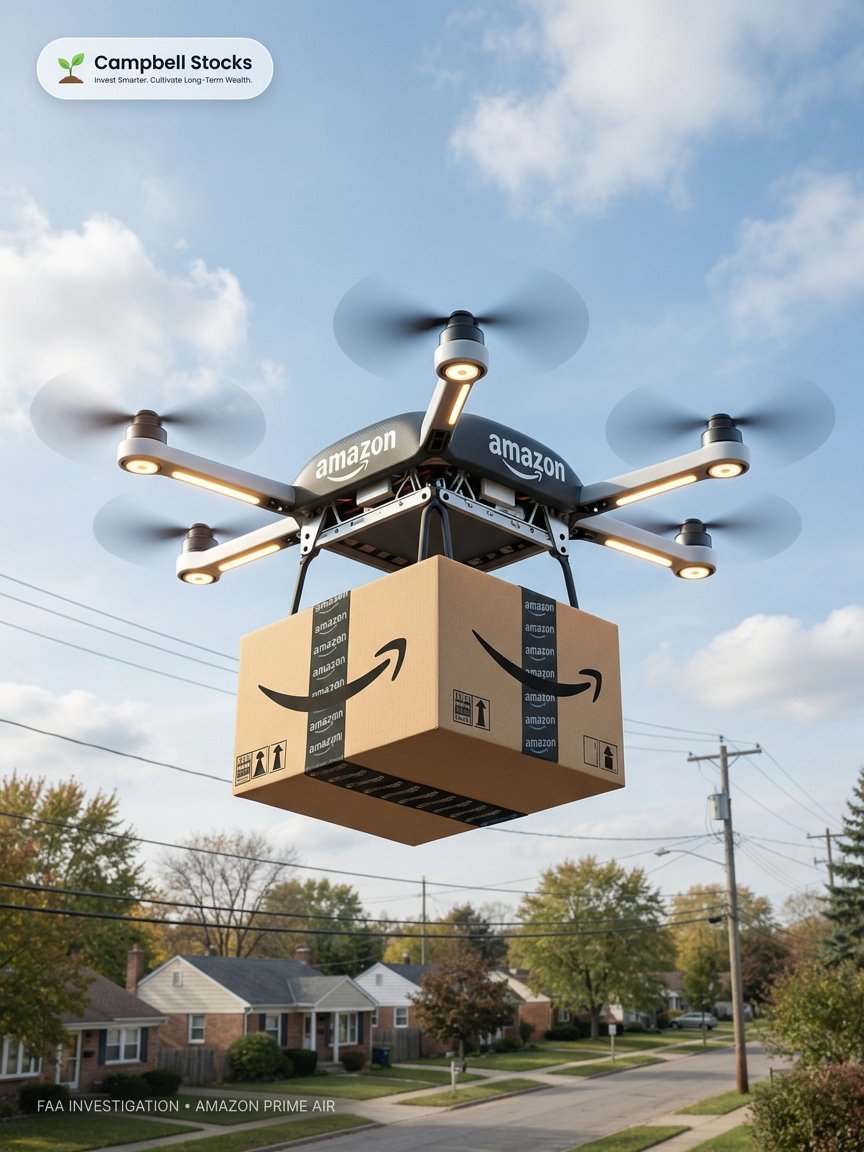
The Federal Aviation Administration (FAA) has launched an investigation after an Amazon Prime Air delivery drone struck overhead utility lines and crashed onto a residential garage roof in Huntington Woods, a suburb north of Detroit, Michigan.
The Federal Aviation Administration (FAA) has launched an investigation after an Amazon Prime Air delivery drone struck overhead utility lines and crashed onto a residential garage roof in Huntington Woods, a suburb north of Detroit, Michigan. While mainstream coverage has focused largely on the spectacle of an 83-pound aircraft tangled in neighborhood wires, the incident points to a far more consequential question for Wall Street: how close is autonomous aerial delivery to becoming a profitable, scalable business model?
According to a preliminary FAA report, the crash occurred on Friday, November 20, at approximately 4:30 p.m. local time. The aircraft, an upgraded MK30 delivery drone, had just completed dropping off a customer's bottle of shampoo when it clipped a neighbor's fiber-optic cable during takeoff, lost a propeller, became entangled in an electrical service line, and landed on an adjacent garage roof.
No injuries were reported, though the impact damaged shingles on the corner of the garage. Local utility provider DTE Energy temporarily cut power to the property so crews and Amazon recovery teams could safely disentangle and remove the aircraft later that evening.
Amazon responds as federal scrutiny intensifies
Confirming the incident, an Amazon spokesperson said the company is in direct contact with the affected resident and has committed to covering the roof repairs.
"On Friday, a Prime Air drone landed on a resident's shed during a delivery in Huntington Woods, Michigan," the spokesperson said. "There were no injuries, the drone has been removed and we are in contact with the resident. Safety is our top priority, and incidents are extremely rare. Anytime a delivery does not go as planned, we investigate what happened."
The National Transportation Safety Board (NTSB) also confirmed it is gathering preliminary information on the crash to determine whether to open a parallel investigation. For investors tracking Amazon (NASDAQ: AMZN), the Michigan crash, the first publicly reported Prime Air accident in metro Detroit since Amazon launched service in the area in 2025, highlights the structural friction between Silicon Valley’s automation timeline and the physical reality of suburban infrastructure.
The suburban wire problem isn't a software bug, it’s an infrastructure bottleneck
Amazon has spent nearly 13 years, since Jeff Bezos first unveiled Prime Air on 60 Minutes in December 2013 trying to turn drone delivery into a routine retail utility. Over that period, the company has poured billions of dollars into custom aircraft engineering, regulatory lobbying, and autonomous sense-and-avoid computer vision.
Yet the Huntington Woods crash exposes a persistent physical vulnerability that algorithms alone have struggled to eliminate: low-altitude suburban clutter. Unlike high-altitude commercial aviation, where airspace is mapped and controlled, last-mile delivery drones operate in the chaotic 20-to-100-foot zone filled with thin fiber-optic cables, sagging service drops, tree canopies, and backyard structures.
Even the flagship MK30 drone, introduced specifically for quieter flight, lighter weight, and upgraded obstacle-avoidance sensors has now encountered recurring wire-strike probes across multiple states, including earlier FAA investigations in Texas and Arizona. Every time a drone clips an unmapped residential line, it triggers federal inquiries, temporary flight pauses, and costly manual recovery dispatches, undermining the very labor savings automation is meant to deliver.
Competitive pressure from rivals taking a different path
Amazon’s infrastructure hurdles also highlight a widening strategic divide in the drone delivery race. While Amazon has insisted on building proprietary aircraft and operating directly from its own fulfillment centers, rivals have pursued leaner, partnership-driven models:
-
Alphabet’s Wing has focused heavily on lightweight tether-drop systems that allow drones to hover higher above trees and power lines rather than descending close to rooftops and fences.
-
Walmart, partnering with Wing and Zipline across major U.S. metro areas, has leveraged its existing network of thousands of suburban stores as local launch hubs, avoiding the need to build new aviation infrastructure from scratch.
What investors should watch next
For Amazon shareholders, Prime Air remains a long-term moonshot rather than a near-term earnings driver compared to high-margin engines like Amazon Web Services (AWS) and digital advertising. Still, as Amazon pushes to expand drone deliveries to hundreds of U.S. cities, regulatory tolerance for low-altitude incidents will determine how fast that rollout can scale.
If federal investigators mandate stricter altitude buffers, additional visual observers, or hardware modifications to the MK30 fleet, Amazon’s timeline for turning Prime Air from a 13-year R&D expense into a commercial profit center could stretch even further into the future.
Figures and incident details are based on preliminary Federal Aviation Administration (FAA) disclosures, National Transportation Safety Board (NTSB) updates, and company statements as of November 24, 2026. This article is for information only and is not investment advice.
This article is for general information and education only. It is not financial, investment, tax or legal advice. Markets carry risk, so do your own research or speak to a licensed adviser before you invest.
Other News
Top Stories- 1 Dangote Refinery Set for Historic NGX Listing on December 1 After SEC Approves Allotment Plan
- 2 Core PCE Inflation Climbs to 3.3% in October as U.S. Q3 GDP Surges to 4.3%, Sealing December Fed Rate Hike
- 3 U.S. Treasury Yields Edge Lower Ahead of Critical PCE Inflation Report and Holiday Closure
- 4 Dell Revenue Doubles to $54.9 Billion in Q3 as AI Server Backlog Surges to $132.3 Billion







Comments (0)
You must be logged in to post comments.
No comments yet. Be the first to start the conversation!