
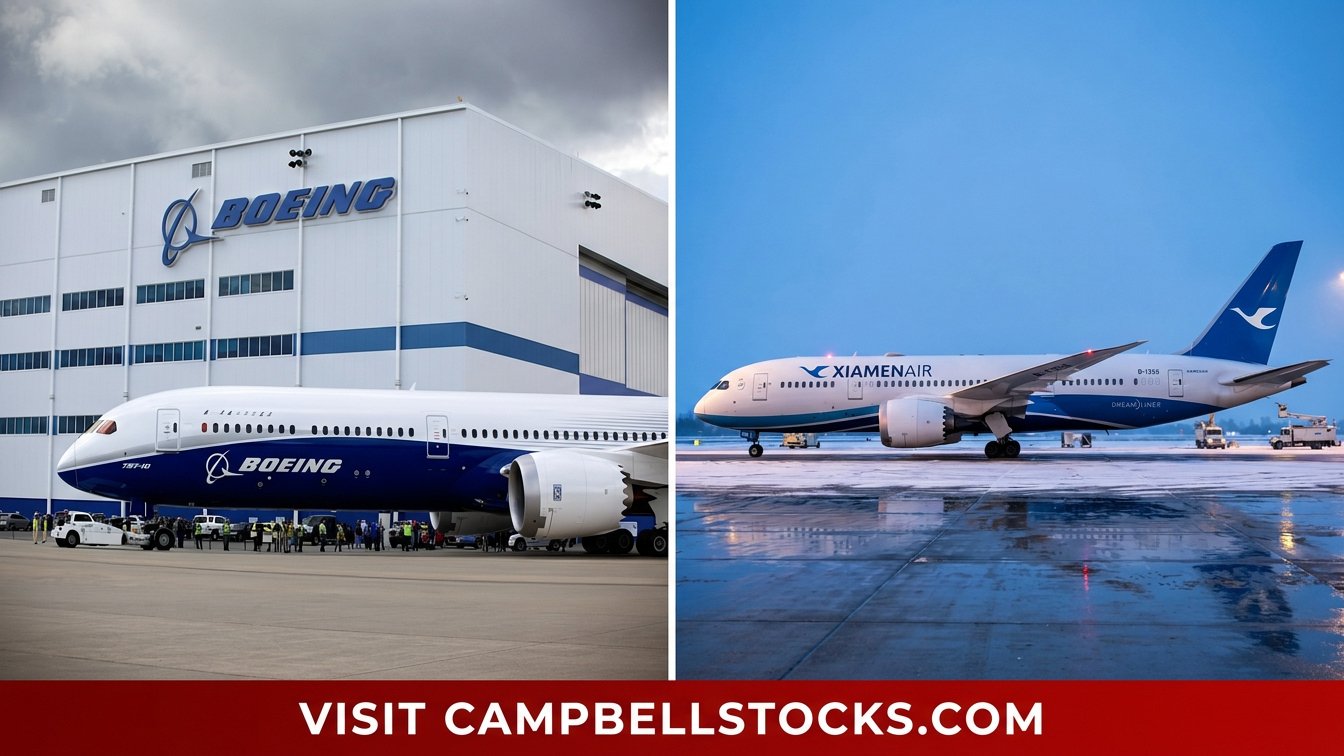
China’s Xiamen Airlines has agreed to purchase 50 Boeing 737-8 (737 MAX 8) jets valued at approximately $7.4 billion at list price, marking Boeing’s first major mainland Chinese order since 2017, though deliveries scheduled between 2031 and 2034 mean the deal provides long-term backlog stability rather than immediate near-term cash flow.
China’s Xiamen Airlines has signed a landmark agreement to purchase 50 Boeing 737-8 (737 MAX 8) passenger jets carrying a combined catalog price of approximately $7.4 billion (49.66 billion yuan) marking Boeing’s first major commercial jet order from a mainland Chinese airline since 2017.
Disclosed in a regulatory filing late Tuesday by parent company China Southern Airlines, which holds a 55% controlling stake in Xiamen Airlines, the deal landed just one day after U.S. President Donald Trump told CNBC he expects China to purchase an additional 250 Boeing aircraft following his bilateral meeting with Chinese President Xi Jinping at last week’s APEC summit in Shenzhen.
While mainstream headlines have focused largely on the diplomatic thaw and Trump’s "250 more jets" forecast, the deeper operational, financial, and competitive mechanics inside China Southern’s exchange filing reveal a far more calculated story for aviation and equity investors.
What Actually Happened and Why the 2031–2034 Schedule Matters
Under the terms signed on November 24, Xiamen Airlines will take delivery of the 50 single-aisle jets in batches between 2031 and 2034. Although Boeing’s published list price puts the transaction at $7.4 billion (roughly $148 million per aircraft), China Southern confirmed that Boeing granted a substantial commercial discount, keeping the final net price confidential. Payment will be structured through installment-based advance deposits, with the remaining balance settled upon delivery of each jet using a mix of Xiamen Airlines’ internal cash flows, commercial bank loans, and capital-raising facilities.
For investors analyzing Boeing NYSE: BA , that five-to-eight-year delivery window is the critical detail most quick news briefs overlook:
- Zero Near-Term Revenue Relief: Because deliveries do not begin until 2031, the contract provides no immediate boost to Boeing’s 2026 or 2027 cash flows. Instead, it locks in long-term production backlog stability well into the next decade.
- Regulatory Hurdles Still Stand: The contract is not yet unconditional. It still requires formal approval from China Southern Airlines’ shareholders and clearance from relevant Chinese government authorities before Boeing can fully book the jets into its firm order backlog.
- A Dramatic Reversal From 2025 Tariff Returns: The symbolism is striking. In April 2025, at the height of tit-for-tat bilateral tariffs, a brand-new 737 MAX 8 already painted in Xiamen Airlines livery was famously flown back to Boeing’s Seattle hub because tariff markups made taking delivery financially unviable. Signing a fresh 50-jet order 19 months later underscores how quickly trade diplomacy has reopened China’s airspace to U.S. manufacturers.
The Local Infrastructure Trigger: Xiamen Xiang’an International Airport
Beyond Washington-Beijing politics, Xiamen Airlines has a pressing operational reason to secure narrowbody capacity for the early 2030s. The carrier is preparing to relocate its primary hub operations to the newly constructed Xiamen Xiang’an International Airport in southeastern Fujian Province, a massive coastal aviation hub scheduled to begin operations at the end of 2026.
Moving into a major new hub creates multi-year route expansion requirements across domestic Chinese trunk routes and regional Southeast Asian corridors. Ordering 50 fuel-efficient 737-8 aircraft now ensures Xiamen Airlines has guaranteed delivery slots during the airport's phase-two growth window between 2031 and 2034, rather than getting stuck behind global carriers in an already sold-out narrowbody market.
Dual-Sourcing Strategy: Balancing Boeing Against Airbus
Another detail frequently glossed over in political coverage is that China Southern Group is deliberately avoiding single-vendor dependence. In April 2026, China Southern and Xiamen Airlines signed an agreement to purchase 137 Airbus A320neo-family jets.
By pairing this week’s 50-jet Boeing order with its earlier Airbus commitment, the group is executing a classic dual-sourcing hedge. Operating both Airbus and Boeing narrowbodies protects the airline against single-manufacturer supply chain bottlenecks, engine delivery delays, and geopolitical tariff shocks, while giving management stronger pricing leverage over both Western planemakers.
Separating Trump’s "250 More Jets" Forecast From Firm Orders
Investors also need to distinguish between confirmed corporate filings and political projections. In May 2026, Beijing committed to purchasing 200 Boeing jets following Trump’s state visit. On Monday, Trump told CNBC he had "sold 250 Boeings to China" and expected Beijing to buy "another 250" which would push total purchases toward 500 aircraft.
However, neither Boeing nor Chinese aviation authorities have confirmed a separate 250-jet contract, and China Southern’s filing did not clarify whether Xiamen’s 50 planes form part of the earlier 200-jet framework or represent new incremental demand.
Key Investor Takeaways
For market participants watching Boeing and global aerospace suppliers, the Xiamen Airlines deal delivers three clear signals:
Boeing has ended its nine-year sales drought in mainland China by securing a 50-jet order, avoiding permanent exclusion from the world's second-largest aviation market against rivals Airbus and COMAC. However, investors should rely on formal stock exchange disclosures from individual airlines like Air China, China Eastern, or Hainan Airlines rather than headlines, as political estimates of 250 additional planes remain unconfirmed upside rather than guaranteed backlog.
Beyond Boeing's sentiment boost, engine maker CFM International, a joint venture between GE Aerospace and Safran that exclusively powers the 737 MAX, stands to win long-term, high-margin service revenue from 100 new LEAP-1B engines entering service in the 2030s.
Figures and transaction details are based on China Southern Airlines’ Hong Kong Stock Exchange filing, company disclosures, and market reports as of November 25, 2026. This article is for information only and is not investment advice.
This article is for general information and education only. It is not financial, investment, tax or legal advice. Markets carry risk, so do your own research or speak to a licensed adviser before you invest.
Other News
Top Stories- 1 Dangote Refinery Set for Historic NGX Listing on December 1 After SEC Approves Allotment Plan
- 2 Core PCE Inflation Climbs to 3.3% in October as U.S. Q3 GDP Surges to 4.3%, Sealing December Fed Rate Hike
- 3 U.S. Treasury Yields Edge Lower Ahead of Critical PCE Inflation Report and Holiday Closure
- 4 Dell Revenue Doubles to $54.9 Billion in Q3 as AI Server Backlog Surges to $132.3 Billion

Comments (0)
You must be logged in to post comments.
No comments yet. Be the first to start the conversation!