

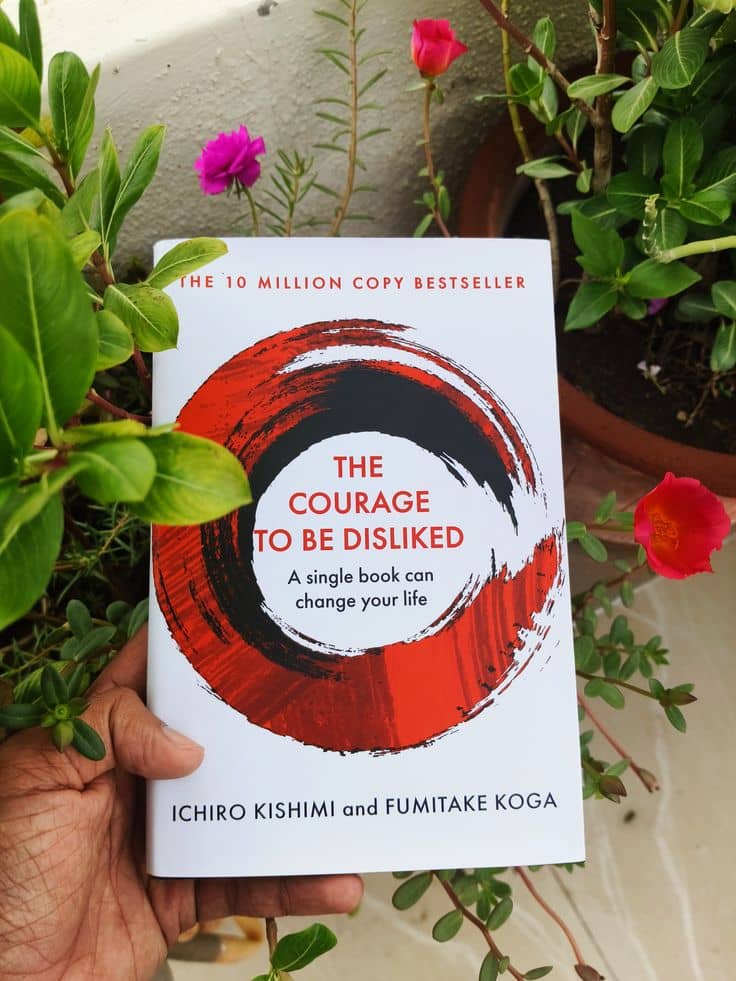
The Courage to Be Disliked Review: 5 Life Changing Ideas That Challenge Everything You Believe About Happiness
The Courage to Be Disliked by Ichiro Kishimi and Fumitake Koga is a self-development book based on the ideas of Austrian psychologist Alfred Adler. It explores how people can become happier and more confident by taking responsibility for their own lives rather than allowing their past, other people's opinions, or social expectations to control them.
“The cost of freedom in interpersonal relationships is that one is disliked by other people.”
Some sentences make you pause. That one made me stop completely.
I came to The Courage to Be Disliked expecting another thoughtful self-help book. Instead, Ichiro Kishimi and Fumitake Koga delivered something far more challenging: a philosophical conversation that forces you to question how much of your life is actually yours.
Based on the psychology of Alfred Adler, the book explores trauma, relationships, happiness, self-worth, freedom, and the uncomfortable price of living according to your own values. And yes, it can be uncomfortable. But that is precisely why it works.
The audiobook makes the experience even more compelling. Narrated by Noah Galvin, Graeme Malcolm, and January LaVoy, the dialogue between the skeptical young man and the philosopher feels remarkably natural. Their performances give the philosophical arguments personality, tension, and emotional weight.
At times, I found myself pausing the audiobook simply to sit with an idea.
Because The Courage to Be Disliked isn't really asking, “How can I become happier?”
It's asking something much more confronting:
“What would your life look like if you stopped living for everyone else's approval?”
Here are five ideas from the book that stayed with me;
1. Your past doesn't have to control your present
One of the book's most provocative ideas is Adler's distinction between "etiology" and "teleology".
In simple terms, we often explain our present circumstances by looking backward: our childhood, our failures, our heartbreaks, our rejection, our trauma, or the things that happened to us. Rather than seeing the past as the ultimate cause of our present behavior, the book asks us to consider the goals our present behavior might be serving.
It doesn't mean painful experiences weren't real. It doesn't mean difficult circumstances don't affect us. Rather, it challenges the idea that our history has the final word on who we become.
Because if your past completely determines your future, you are trapped.
But if you have some agency over the meaning you give your experiences and the direction you choose from here, you have something incredibly valuable:
"choice."
This was one of the most empowering ideas in the book for me.
You may not be able to rewrite your history.
But you can decide who holds the pen from this point forward.
2. Many of our deepest problems are interpersonal
Adler's claim that “all problems are interpersonal relationship problems” sounds extreme at first. But the more you think about it, the more interesting it becomes. Think about how much of everyday life revolves around other people.
- We worry about being accepted.
- We compare ourselves with colleagues.
- We wonder what our families think.
- We fear rejection.
- We crave recognition.
- We replay conversations.
- We measure ourselves against people we see online.
Even when the problem appears to be “about us,” there is often a relationship or our perception of a relationship somewhere underneath it.
The book doesn't argue that human connection is the problem.
It suggests that understanding our relationships more honestly can be the beginning of freedom, That means examining where we seek approval, where we compare ourselves with others, where we feel inferior, and where we're trying to control things that aren't actually ours to control.
For anyone who spends too much time worrying about what other people think, this section alone is worth the price of the book.
3. The cost of freedom is being disliked
This is the idea that gives the book its unforgettable title. Most of us want freedom, but we're often unwilling to pay its price.
Because genuine freedom means accepting that "not everyone will approve of you." If you need everyone to like you, you'll constantly adjust yourself to fit their expectations.
- You'll say yes when you want to say no.
- You'll choose what looks impressive instead of what feels meaningful.
- You'll measure your decisions by applause rather than conviction.
Eventually, you may become very good at being liked and very bad at being yourself.
The philosopher's message is simple but difficult:
Other people's opinions of you are not yours to control.
That doesn't mean becoming selfish, rude, or indifferent to other people.
It means understanding that living authentically will inevitably disappoint some people.
And that's okay.
In fact, the book argues that being disliked can be evidence that you're finally making choices that belong to you.
That idea stayed with me long after I finished listening.
4. Learn to separate your tasks from everyone else's
This may be the most immediately useful concept in the entire book.
The idea is called "separation of tasks".
The basic question is:
> “Whose task is this?”
Consider how much mental energy we spend trying to control things that ultimately belong to other people.
- Will they approve of my decision?
- Will my parents be proud of me?
- Will my friend understand?
- Will my coworkers respect me?
- Will strangers on the internet agree with me?
- You can control your choices.
- You can control how honestly and respectfully you behave.
- But you cannot control how another person interprets you.
That is their task.
- Once you understand this distinction, something starts to change.
- You stop carrying responsibility for everyone's reactions.
- You stop trying to manage every opinion.
- You stop treating someone else's disappointment as proof that you've done something wrong.
And you start putting your energy back where it belongs:
"your own life."
The audiobook format works particularly well here because the philosopher and young man essentially walk through the argument together. The young man's objections often sound like the objections we would make ourselves, which makes the conversation surprisingly engaging.
5. Happiness isn't about being special, it is about belonging and contributing
Modern culture constantly tells us that happiness comes from becoming exceptional.
- Be more successful.
- Make more money.
- Build a personal brand.
- Get more followers.
- Become extraordinary.
- Stand out.
But Adler's philosophy offers a very different definition of happiness.
The book argues that genuine happiness is connected to belonging and contribution.
In other words, happiness isn't necessarily found in proving that you're better than everyone else.
It can be found in recognizing that you're already part of something larger than yourself and that what you do can contribute to it.
That is a radically different way of looking at life.
- You don't have to become famous to matter.
- You don't have to be extraordinary to have value.
- You don't have to win everyone's admiration.
- You can contribute through your work, your relationships, your kindness, your creativity, your family, your community, or the small things you do every day that make someone else's life a little better.
There's something deeply freeing about that.
Instead of asking:
“How can I become special enough to be happy?”
You start asking:
“How can I participate meaningfully in the life I'm already living?”
That is a much more sustainable definition of happiness.
Is The Courage to Be Disliked Worth Reading?
Yes, especially if you're tired of conventional self-help advice. This isn't a book that simply tells you to “think positive” or repeat affirmations until your problems disappear.
- It challenges you.
- Sometimes aggressively.
- Sometimes uncomfortably.
And occasionally, you may find yourself arguing with the philosopher.
That's part of the experience.
The book's dialogue format also makes difficult philosophical ideas surprisingly accessible. Rather than presenting Adler's psychology as a dry academic lecture, Kishimi and Koga turn it into a conversation between two people who disagree and that makes the ideas easier to wrestle with.
I especially recommend it if you:
- Overthink what other people think of you
- Struggle with people-pleasing
- Have difficulty setting boundaries
- Constantly compare yourself with others
- Feel trapped by your past
- Want to understand Adlerian psychology
- Are searching for a different perspective on happiness
- Enjoy books that challenge rather than simply reassure you
If you prefer listening to books, I highly recommend giving the audiobook a try.
The performances by Noah Galvin, Graeme Malcolm, and January LaVoy add another dimension to the philosopher-and-youth format. The different voices make the debate feel like an actual conversation rather than a lecture, which helps keep the book engaging even when the ideas become dense.
And because many of the book's concepts are worth sitting with, the audiobook is particularly well suited to listening during a walk, commute, or quiet evening.
The Courage to Be Disliked is not a book that promises to make life easier.
It offers something more useful:
"a different way of looking at your life."
If these ideas speak to you, I highly recommend checking out The Courage to Be Disliked for yourself.
Read or listen to The Courage to Be Disliked on Amazon/Audible
Disclosure: This post contains an affiliate link. If you purchase through the link, I may earn a commission at no additional cost to you.
Availability, pricing, and audiobook options may vary.
You Might Also Like