
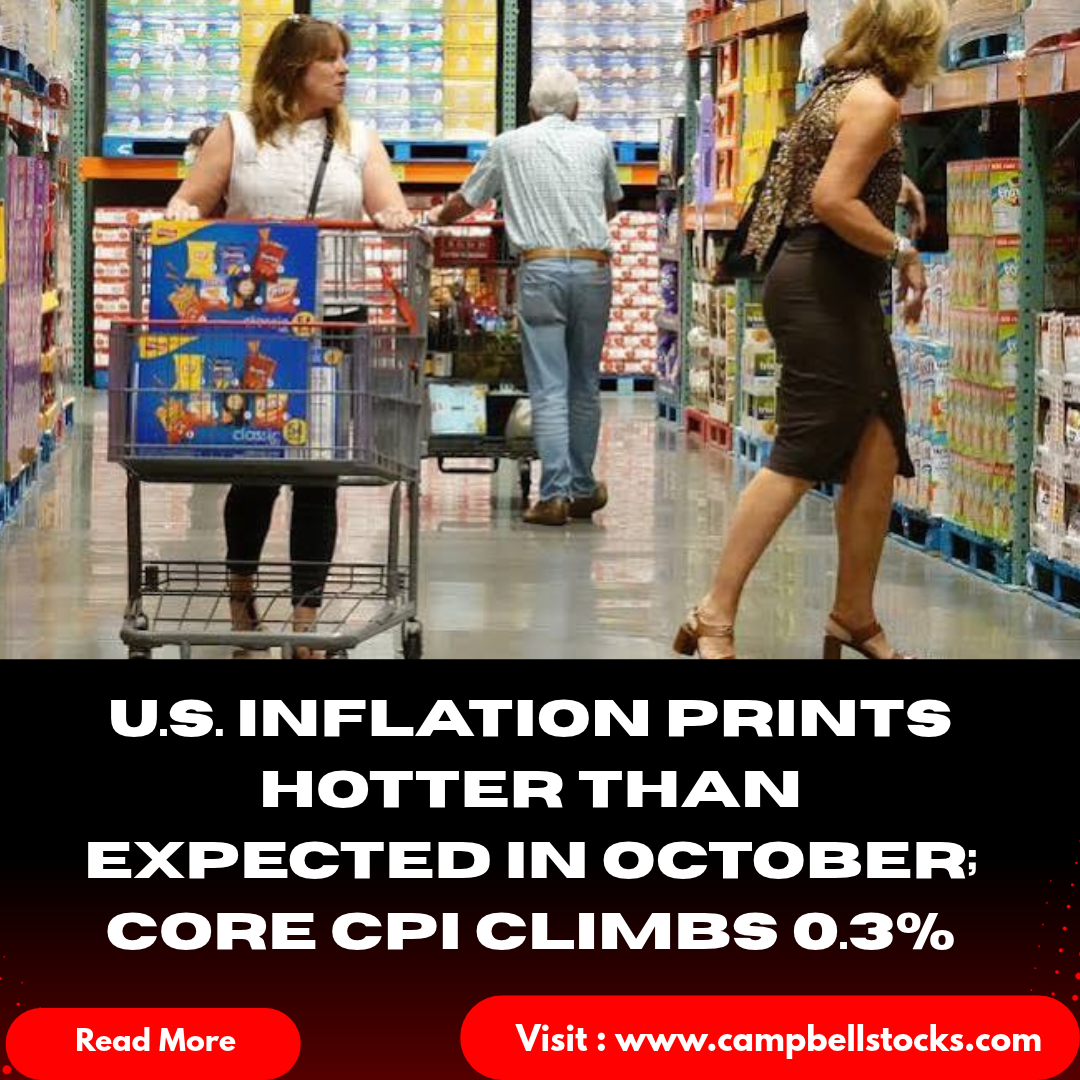
U.S. consumer prices rose faster than anticipated in October 2026, driven by a surge in energy commodities and persistent structural shelter costs that complicate the Federal Reserve's next policy move.
According to the official data released by the Bureau of Labor Statistics (BLS) on Tuesday, November 10, 2026, the Consumer Price Index (CPI) advanced 0.4% month-over-month. This reading outpaced the standard Wall Street economist consensus projection of 0.3%.
Crucially, no official year-over-year (YoY) annual inflation rate was published for October due to baseline statistical gaps stemming from the federal government shutdown in October 2025.
The sequential monthly acceleration proves that price stabilization is flattening out at a higher floor than financial models anticipated, fueled primarily by non-discretionary categories:
The Shelter and Food Burden: The index for shelter increased by 0.3%, single-handedly accounting for more than 30% of the aggregate monthly all-items increase. Food costs amplified the pressure on households, climbing 0.5% over the month.
Energy Stays Firm: Energy commodities moved up by 0.7% in October, compounding the massive 5.2% spike recorded in September as geopolitical tensions and energy supply disruptions continue to impact market infrastructure.
The Deflationary Exceptions: Consumer relief was tightly isolated to very few categories. Used cars and trucks fell -1.2%, while communication costs saw a minor -0.1% decline.
This hot inflation print, landing directly on the heels of last Friday's blowout 165,000 nonfarm payroll jobs report, has triggered rapid volatility across global financial markets:
Treasury Yields Spike: In the immediate minutes following the 8:30 a.m. ET release, the yield on the interest-rate-sensitive 2-year U.S. Treasury surged by 0.17 percentage points, climbing to 4.71% as bond prices tumbled. Concurrently, the U.S. Dollar Index (DXY) jumped 0.3%.
The 50-Basis-Point Threat: The data puts severe pressure on central bank policymakers. Prior to the release, Fed officials explicitly warned that a Core CPI print of 0.3% or higher would force the committee to debate a larger, half-point (50 bps) interest rate hike at the December 8–9 policy meeting, rather than a standard quarter-point move.
With a tight 4.1% unemployment rate and sequential core inflation holding sticky at 0.3%, the economic landscape is firmly locked in a "higher-for-longer" interest rate environment heading into 2027.
This article is for general information and education only. It is not financial, investment, tax or legal advice. Markets carry risk, so do your own research or speak to a licensed adviser before you invest.
Other News
Top Stories- 1 Anthropic’s $1.4 Trillion Nasdaq Test Arrives as Wall Street Splits on AI Spending
- 2 Seplat’s ₦1,358.34/$1 Dividend Fixing Sparks a ₦328 Billion NGX Rebound
- 3 Why Wall Street Rewarded Wendy’s for Rejecting a $1.4B Buyout and Scaling Back Breakfast
- 4 How Microsoft’s 5-Hour Outage Disrupted OpenAI, Anthropic, and Corporate Earnings






Comments (0)
You must be logged in to post comments.
No comments yet. Be the first to start the conversation!