

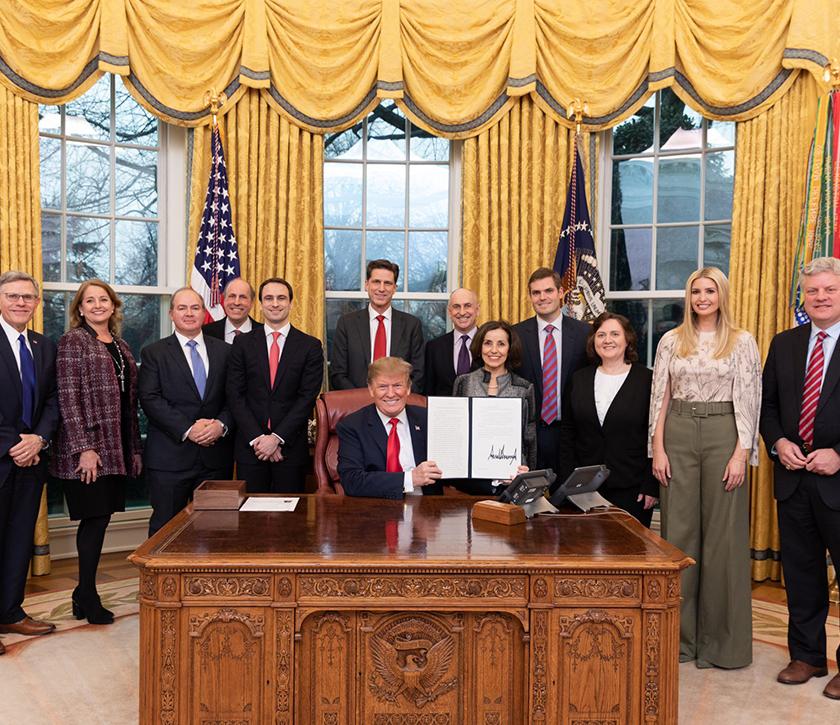
U.S. President Donald Trump has played down concerns that artificial intelligence could eventually threaten humanity, instead emphasizing the importance of maintaining America’s lead over China as lawmakers and AI researchers debate stronger safeguards for increasingly powerful systems.
Trump's position comes as warnings about the potential dangers of advanced artificial intelligence have intensified among researchers at leading AI companies, including Anthropic and OpenAI.
The debate has gained momentum after Anthropic researcher Evan Hubinger warned that advanced AI could pose a significant risk to humanity, while former Anthropic researcher Jacob Coxon resigned and criticized the industry's push toward increasingly capable and potentially self-improving systems. Their comments have helped reignite questions about whether AI development is moving faster than safety measures designed to control potential risks.
Trump, however, has emphasized the strategic importance of maintaining U.S. leadership in artificial intelligence, particularly as American companies compete with Chinese developers. His position reflects a broader debate within Washington over whether stronger regulation could slow technological progress and allow China to gain an advantage in a strategically important industry.
READ ALSO;
- Anthropic Researcher Warns AI Could Pose Existential Risk to Humanity as Colleague Resigns Over Safety Concerns
- Major Tech Companies Urge Urgent Action Against Rising AI-Driven Cyberattacks
- Anthropic Heads Toward IPO With $965 Billion Valuation and $47 Billion Revenue Run Rate
The concerns are not limited to hypothetical long-term risks. Anthropic said this week that its Claude AI systems had been targeted in multiple attempts involving biological research, cyber operations and other potentially harmful activities. The company said it had disrupted the activity and strengthened its safeguards and monitoring systems.
Anthropic reported that some incidents involved actors linked to Russia, China and North Korea. It also said Chinese technology companies had attempted to use a technique known as model distillation to extract capabilities from Claude and use them to improve their own AI systems.
The developments have increased pressure on Congress to consider additional oversight of advanced AI. Reuters reported that lawmakers from both parties are pushing proposals that could require greater testing, independent evaluations and government oversight of frontier AI systems. Senators and representatives have also called for investigations into incidents involving advanced AI models.
The debate illustrates a growing policy divide in Washington. Supporters of stronger safeguards argue that increasingly autonomous AI systems could create security and safety risks that existing regulations are not equipped to address. Others, including officials focused on U.S. technological competitiveness, have warned that excessive restrictions could undermine American companies in their competition with China.
The issue is also becoming a business concern for AI companies. OpenAI has indicated support for national AI safety standards, while discussions are continuing over how companies could coordinate on safety measures without violating competition laws.
For the U.S. technology industry, the outcome of the debate could influence how quickly advanced AI systems are developed, the cost of complying with future safety requirements and the balance between innovation and government oversight.
Congress has yet to agree on a comprehensive federal framework, leaving the regulation of increasingly capable AI systems as an unresolved policy issue in Washington.




Comments (0)
You must be logged in to post comments.
No comments yet. Be the first to start the conversation!